



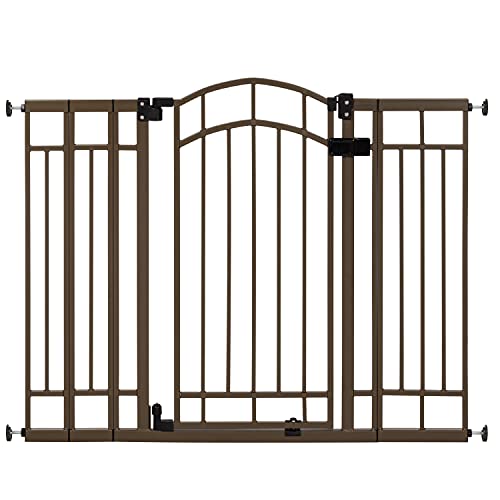
Start with how your dog actually challenges a barrier
Gates fail in different ways depending on what a dog does to them. A dog that jumps needs height. A dog that chews needs a frame and latch that resist teeth, not just weight. A doorway or opening wider than a standard gate needs a product built to span it rather than a standard gate stretched to its limit. Most buyers pick a gate by size and price and only discover the mismatch after the dog finds the weak point, so it's worth working through each challenge on its own before shopping.
Height for a dog that jumps
Standard gates run roughly 24", 30" tall, which is sized around an average dog, not yours. The relevant comparison isn't your dog's height at rest but its jump height: a dog that can comfortably clear a couch back, a low fence, or a kitchen counter is going to treat a 29" gate the same way. As a rough guide, a gate should clear a jumping dog's reach with real margin, not just its standing shoulder height, a 36"-tall gate gives noticeably more buffer than the standard height for dogs in this category, and once a dog succeeds at clearing a gate once, it tends to keep trying.
Bar orientation matters alongside height. A gate with horizontal rails can function as a ladder for a dog that likes to climb rather than jump, giving it paw-holds up the front of the gate. A gate with vertical slats or a flat mesh-style panel doesn't offer the same foothold, which makes it the better match for a climber even at the same overall height.
Materials and latches for a dog that chews
Frame material sets the baseline for chew resistance. Metal-frame gates, steel tube construction, hold up to chewing, pawing, and general wear better than any other common material, which makes them the sensible default the moment chewing is a known behavior. Wood or wood-composite gates look better in a living space but dent and splinter under sustained chewing in a way metal doesn't. Mesh or soft-sided fabric gates are lightest and most portable, useful for travel, but they're the weakest option against teeth and better treated as a short-term or supervised-use product than a permanent fixture for a chewer.
Frame material isn't the whole story, though, latches, hinges, and extension connectors are frequently the actual failure point, and they're often plastic even on gates with an otherwise all-metal frame. A metal-frame gate with a plastic latch mechanism is only as chew-resistant as that latch. When a dog is a known chewer, check the latch and hinge material specifically rather than assuming an all-metal-looking gate is entirely metal, and expect to inspect or replace these smaller parts over time even on an otherwise durable gate.
Freestanding and extra-wide options for openings a standard gate can't span
A standard gate's adjustable range typically tops out well under six feet, even with an extension kit attached, which leaves open-plan doorways, wide hallway openings, and irregularly shaped rooms without a straightforward fixed-gate option. Two paths work here. The first is an extra-wide gate model built specifically for wider spans, which some manufacturers offer as a dedicated product rather than a standard gate plus add-on extensions. The second is a freestanding, multi-panel pen or barrier that doesn't attach to a wall at all, it configures into a straight run, an L-shape, or an enclosure, which lets it cover a width or shape no rectangular gate can match.
Freestanding barriers trade fixed-mount security for that flexibility. Because they're not anchored to a wall or frame, a large or determined dog can push, tip, or walk a lightweight pen out of position. If you're using a freestanding option for a wide opening and the dog is strong, look for a model with ground-stake or anchor points, and treat it as best suited to supervised use rather than assuming it holds the same way a properly mounted gate does.
Walk-through doors and pet doors when more than one challenge is in play
A built-in walk-through door matters more than it seems once you're crossing the gate several times a day, but it matters even more for a jumping or testing dog, because a door that's been left open by a distracted person is often the actual moment a jumper or chewer gets through, not a failure of the gate itself. An auto-closing, self-latching door removes that human-error window, which is worth prioritizing for a dog that's already shown it will test any gap.
Multi-pet households layering a cat or small dog into the picture can look at gates with a small secondary pet door built into the base panel, sized for the smaller pet to pass through independently. Size that opening against the actual smallest pet in the house rather than assuming "small dog door" covers any pet under a certain breed label, a motivated small-to-medium dog can sometimes fit through an opening sized loosely for a cat.
When more than one challenge applies at once
A tall, athletic dog that also chews needs both traits addressed together, a tall mesh gate solves the jumping problem and creates a new one, since mesh is the weakest material against teeth. In that case, prioritize height and metal frame construction together over any single feature, and treat latch material as a non-negotiable check rather than an afterthought. Where a wide opening is combined with a jumper or a strong dog, an extra-wide metal gate built for the span is generally a safer match than a freestanding pen, since it can be properly mounted rather than relying on the pen's own weight and footprint to stay in place.