




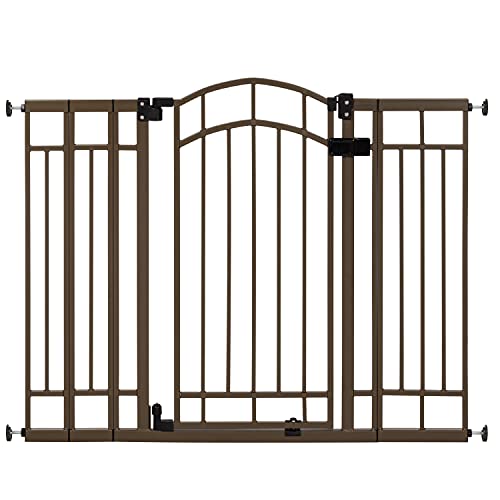
How to Choose a Dog Safety Gate
A dog gate looks like a simple product until you actually need one to do a specific job, hold a jumper back from the kitchen, block the top of a staircase, or let a cat through while keeping a dog in. The mounting method, the height, and the material all matter more than they look like they would from a product photo. Everything below is drawn from aggregated verified owner reviews and manufacturer specifications, not hands-on lab testing, so use it as a buyer's framework rather than an installation guarantee.
Pressure-mount vs hardware-mount, the one rule that actually matters
This is the single most important distinction in the category, and it's a safety issue, not a preference. A pressure-mount gate holds itself in place with spring-loaded arms pressing outward against the door frame or wall on either side. No drilling, no screws, you extend it, twist a tension knob, and it locks in by friction. That makes it fast to install and easy to remove, which is why it's the default for doorways, hallways and the bottom of a staircase.
It is not rated, by any manufacturer, for the top of a staircase. A gate held in place by friction can be pushed loose by a large dog leaning or jumping against it, and at the top of stairs that failure means a fall, not just an escaped dog. A hardware-mount gate solves this by screwing directly into the door frame, trim or wall studs. It cannot be knocked loose the way a pressure-mount gate can, which is exactly why it's the only mounting method that belongs at the top of a staircase. Some gates, like the Ingenuity pick above, are designed to convert between the two methods depending on where you're installing them, hardware mount at the top of the stairs, pressure mount everywhere else in the house.
The trade-off is real: hardware mounting means drilling holes, and removing the gate later usually means filler and touch-up paint. Decide the mounting method by location first, and only then look at style, height or price, a beautiful gate in the wrong mounting category is a hazard, not a bargain.
Measuring the opening before you buy
Every gate lists an adjustable width range, and it's worth measuring twice before ordering. Measure the narrowest point of the opening, door frames, banisters and trim often aren't perfectly square, so measure at both the top and bottom of the space and use the smaller number. Most gates extend a fixed amount past their stated minimum width using built-in telescoping bars, but very few compress much below their stated minimum, so an opening near the bottom of a gate's range is safer to buy for than one near the top. If your opening exceeds a gate's maximum width, check whether the manufacturer sells an extension kit before assuming the product won't work, several gates in this category, including the Regalo pick above, are designed around optional extensions rather than a single fixed size.
Height vs a jumping dog
Standard gates run roughly 24", 30" tall, which is enough for most dogs but not for an athletic, long-legged, or simply motivated jumper. If your dog can clear a kitchen counter or a couch back without much effort, budget for a genuinely taller gate, 34", 36" rather than the standard height, because a dog that can jump a 29" gate on the first try will keep doing it. Height alone isn't the whole story, either: a dog that's a determined climber can sometimes use horizontal bars as a ladder, so a gate with vertical slats or a mesh-style panel is a better match for a climber than one with wide horizontal rails.
Materials, metal, wood and mesh
Metal-frame gates (steel tube or wrought-iron style) are the most common and the most durable against scratching, chewing and general wear, they're the right default for a dog that leans, paws or gnaws at a barrier. Wood or wood-composite gates tend to look more like furniture and blend into a room better, but they're more vulnerable to chew damage and dents than metal, so they suit calmer dogs or households prioritising appearance over abuse-resistance. Mesh or fabric-panel gates are the most portable and lightest option, useful for travel, but they're the weakest against a determined chewer or a dog that tests barriers with its teeth, treat mesh as a short-term or travel solution rather than a permanent fixture for a chewer.
Walk-through doors, and freestanding options for awkward spaces
A gate with a built-in walk-through door is worth paying for the moment you cross it more than a couple of times a day, climbing over a solid panel gets old fast, and a door you open one-handed while carrying laundry or a coffee is a real quality-of-life difference. Auto-closing, self-latching doors reduce the single most common gate failure of all: a door left open by a distracted human. If your household has pets of different sizes, a gate with a small secondary pet door built into the base, sized for a cat or small dog, can solve the two-pet problem without a separate cat flap cut into a wall.
Not every space is a standard doorway, though. Wide, open-plan layouts, oddly angled rooms, or spaces with no wall on either side to mount against are better served by a freestanding, multi-panel pen or barrier that doesn't rely on pressure or hardware mounting at all. The trade-off is stability: a freestanding barrier can be pushed or tipped by a large, motivated dog in a way a properly mounted gate cannot, so treat freestanding options as best suited to supervised use or smaller, less forceful dogs rather than as unattended containment for a powerful one.
Chew and durability considerations
No gate in this category is marketed as chew-proof, and reviewers consistently flag plastic latches, hinges and connector pieces as the parts that fail first under sustained chewing or scratching. If your dog is a known chewer, favour metal-frame construction over wood or mesh, check whether the latch mechanism is metal or plastic, and expect to replace or reinforce a gate over time rather than assuming any barrier is permanent against a truly committed chewer.