Microchip Pet Doors, Safety Gates and Dog Ramps for Access and Mobility
Home accessibility, microchip pet doors, stair safety gates, and IVDD-safe incline ramps. Authoritative veterinary guidelines, anatomical parameters, and sub-category master breakdown.
- 3
- Sub-Categories
- 6
- In-Depth Guides
- 12
- Products Reviewed
- May 2026
- Last Reviewed


Recommended Products


Sub-Category Micro Hubs
In-depth technical analyses, material specifications, and comparative evaluation.
Electronic & Microchip Pet Doors
Detailed evaluation of anatomical parameters, safety standards, and practical recommendations for electronic & microchip pet doors.
Safety Gates & Barriers
Detailed evaluation of anatomical parameters, safety standards, and practical recommendations for safety gates & barriers.
Dog Ramps & Steps
Detailed evaluation of anatomical parameters, safety standards, and practical recommendations for dog ramps & steps.
Every home has thresholds a dog needs help crossing. A back door to the yard, a staircase they shouldn't tumble down, a couch or car tailgate that's too high for aging joints, these are common obstacles. Doors, gates, and ramps solve three different problems: free access, safe containment, and physical assistance. Most households end up needing more than one.
This hub maps the category so you can find the right sub-hub fast. A microchip pet door gives unsupervised yard access, and a dog door for sliding glass door installs is one common style. Safety gates and barriers keep dogs in or out of specific rooms and stairwells. Dog ramps and steps get dogs safely onto furniture, beds, cars, and boats. None of these products are interchangeable, and picking the wrong one is a common, and preventable, source of injuries, escapes, and returns.
Electronic and microchip pet doors let a dog come and go without a human opening a door, using either a collar-worn transmitter or the dog's existing microchip to unlock a flap. They're the right call for dogs with reliable yard manners who need on-demand bathroom access, especially in multi-dog households where a standard flap would let every animal, and the neighborhood cat, through. Sizing, wall vs. door installation, and weatherproofing vary a lot between models. See the full rundown in Electronic & Microchip Pet Doors.
Safety gates and barriers do the opposite job: they block access rather than granting it. A pressure-mounted gate suits adult-supervised zones. A hardware-mounted dog gate for stairs holds firm where pressure-mounted models can't. Freestanding pens for puppies or elderly dogs who need a defined safe zone also fall into this group. If you're comparing specific models, the best dog gates roundup covers current top picks by use case. For the full category breakdown, go to Safety Gates & Barriers.
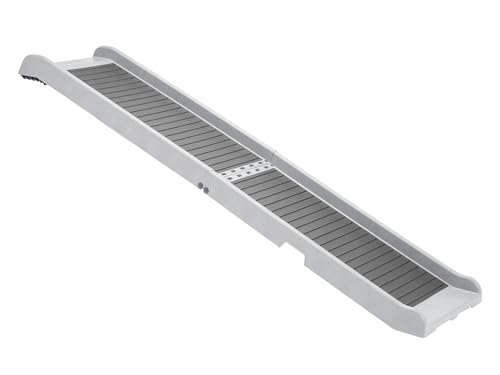
Dog ramps and steps bridge a height a dog can't or shouldn't jump: into the car, onto the bed, into a pool, down porch stairs. A dog ramp for the car and dog steps for the bed matter most for small breeds, seniors, post-surgical dogs, and any breed prone to back problems, where repeated jumping is a real orthopedic risk. Picks by incline, weight capacity, and portability live in best dog ramps; the full guide is at Dog Ramps & Steps.
Start with the problem, not the product. "I need my dog to stop jumping the back fence" is a containment problem, a gate or fence, not a pet door. "My dog whines at the door forty times a day" is an access problem, a pet door. "My dog hesitates before jumping onto the couch" is a mobility problem, a ramp or steps.
For gates, the biggest decision is mount type. A pressure-mounted gate grips between two walls or a doorframe with tension and is easy to move, but it can be pushed loose by a determined or large dog. Never use one at the top of a staircase, where stair safety depends on a secure fit. A hardware-mounted dog gate for stairs bolts into the wall studs and won't budge, which is why it's the standard for stair safety. Measure the opening width precisely. Most gates have an extension range printed on the box, and a gate stretched to its maximum width is weaker than one sized close to its rated range.
For electronic and microchip pet door models, the choice is between a collar-tag transmitter and true microchip reading. A microchip-reading door uses the chip your vet already implanted, so there's no separate collar unit to lose or that falls off during play. Confirm the door's chip-reading standard matches your dog's microchip. Most modern units read ISO FDX-B chips, which cover the vast majority of chips implanted in the US, Canada, UK, and Australia. Flap size should clear your dog's shoulder height and width with a small margin, not be sized to their current weight alone, since a too-small opening becomes a squeeze even for dogs who technically fit.
For ramps, weight capacity is the number that matters most and the one people most often ignore. Check that it comfortably exceeds your dog's adult weight, not just meets it, since dynamic loading (a dog trotting, not standing still) puts more force through the ramp than the static rating implies. Incline angle should be gentle, particularly for a dog ramp for stairs or elevated surfaces, and especially for senior dogs or any breed at elevated risk for intervertebral disc disease (IVDD), dachshunds, corgis, basset hounds, and other long-backed breeds. The American College of Veterinary Surgeons notes that minimizing jumping and using ramps for elevated surfaces is a standard part of managing dogs at risk for or recovering from IVDD (acvs.org). Surface traction matters as much as angle. A smooth ramp on a hardwood floor is a slip hazard regardless of how gentle the incline is, so look for a textured or carpeted surface and non-skid feet.
If you're deciding between a pet door and a gate for the same doorway, remember they solve opposite problems. A gate keeps a dog on one side of a boundary, while a pet door lets them cross it freely. Some households use both: a microchip door to the yard, and a gate keeping that same dog out of the nursery.
Getting the numbers right before you buy saves a return trip. Use this as a general reference, and always check the exact spec sheet for the model you're considering.
| Product | What to measure | Rule of thumb |
|---|---|---|
| Pet door flap | Dog's shoulder height and width, standing | Add 2-3 inches of clearance on each dimension |
| Pressure gate | Doorway or hallway width at the mount points | Choose a model whose range sits mid-way, not at the max extension |
| Hardware gate (stairs) | Opening width plus wall stud location | Confirm studs exist where brackets will anchor |
| Dog ramp | Height from ground to target surface (car bumper, bed, couch) | Add ~1 foot of ramp length for every 4-6 inches of rise for a gentle, senior-friendly angle |
| Dog steps | Height of climb and depth of each tread | Tread depth should exceed the dog's paw length for stable footing |
Senior dogs and dogs with mobility issues generally need a dog ramp for the car or dog steps for the bed before anything else. Arthritis, hip dysplasia, and general joint stiffness make jumping painful even when a dog still attempts it out of habit. A vet or veterinary physical therapist can advise on whether a specific dog's condition calls for a shallow-angle ramp versus dog steps, since the right choice differs by joint versus disc-related conditions.
Containment-focused households should prioritize gates and barriers, often before ramps or doors even enter the picture. That includes puppies still learning house rules, multi-dog homes managing separation at mealtimes, or dogs recovering from surgery who need restricted movement.
Free-access households with a secure, fully fenced yard and a dog with reliable outdoor manners are the best fit for an electronic or microchip pet door. It cuts down on door-scratching and reduces the number of times someone has to get up to let the dog out.
Most homes end up mixing categories over a dog's lifetime. A puppy starts behind gates, graduates to a pet door as an adult, and returns to a dog ramp for car use or dog steps for bed access as a senior.
A few rules apply across the whole category. At the top of any staircase, use a hardware-mounted dog gate for stairs only. A pressure-mounted gate is not rated for stair-top use and can give way under a dog's weight. That distinction is reflected in the consumer safety standards that govern gates sold for both child and pet use, ASTM F1004, the voluntary standard referenced by the U.S. Consumer Product Safety Commission for gates and enclosures. Check gate hardware periodically for loosening, especially in households with a dog that leans or paws at the gate.
For ramps, stability is the main failure point. A ramp that shifts or wobbles mid-crossing can cause a fall that's worse than the jump it was meant to prevent. Test the ramp yourself on the actual surface, car interior, bedside, before trusting a dog on it, and don't leave a ramp deployed at a steep, unsupported angle against a moving vehicle.
For pet doors, security and insulation are the two trade-offs to weigh. Any hole in an exterior wall or door is a potential entry point, so check whether the model you're considering has a locking mode for overnight or when you're away. Look at its energy-efficiency rating too if the door faces a heated or cooled space, since flap material and seal quality vary widely between budget and premium units.
Almost no dog uses a new ramp or pet door confidently on the first try, and skipping the training step is the single biggest reason expensive gear ends up unused. For a ramp, start flat on the ground so the dog can walk its full length without any incline, then raise it gradually over several short sessions, luring with treats and praise rather than lifting or forcing a dog onto it. Never introduce a ramp for the first time at full height against a car or bed. For a microchip pet door, prop the flap open at first so the dog learns the doorway itself is safe, then let them push through with the flap resting lightly closed before enabling full chip-locking. Rewarding calm, voluntary use each time builds the habit far faster than repetition alone.
Installation for a dog door for sliding glass door setups is usually the simplest option, since it fits into a track insert rather than requiring a cut into a wall or solid door. A true wall or door installation involves cutting an opening to the flap's exact dimensions, which is a bigger project and often benefits from professional installation, particularly on exterior walls with insulation or wiring to work around. On keeping other animals out, a true microchip-reading door is meaningfully more secure than a basic flap or even a collar-tag transmitter, since it only unlocks for chip numbers you've programmed in, which stops a neighborhood cat, raccoon, or another household's dog from following your dog through. A collar-transmitter door is more vulnerable if the collar unit is lost, chewed off, or worn by a different animal.
A basic pressure-mounted gate is the cheapest entry point and fine for low-stakes, non-stair doorways. A hardware-mounted dog gate for stairs costs more due to the bracket hardware and installation, but that's the correct trade for stair-top safety, not a place to economize. Electronic and microchip pet doors range widely: a simple flap is inexpensive, while a true microchip-reading, insulated, lockable unit costs significantly more, and the extra spend buys real security and energy efficiency rather than just convenience. Dog ramps and steps price out by weight capacity and material, with a lightweight foam ramp for a small dog at the low end and a heavy-duty, textured, high-capacity ramp for a large or senior dog costing more, justified by the added stability and traction a bigger, less steady dog actually needs.
Wipe down a pet door's flap and frame periodically, since grime and pet hair build up around the seal and can affect how well it closes and insulates. Check gate hardware, hinges, latches, and wall anchors, on a regular schedule rather than only when something feels loose, since a gate that's been leaned on daily for months can work its brackets slowly loose. Ramps with a carpeted or textured surface should be vacuumed or brushed to keep traction from degrading under dirt and fur, and any foldable ramp should be checked for hinge wear at the fold point, since that's the most common failure location on a heavily used ramp.
Using a pressure-mounted gate at the top of stairs. This is the single most common and most dangerous mistake in the category. A pressure gate is not rated for stair-top use and can give way under a dog's weight or a determined push.
Sizing a pet door flap to a dog's current weight instead of shoulder height and width. A flap that's technically wide enough can still feel like a squeeze if it doesn't clear the shoulders with margin, which discourages a hesitant dog from using it at all.
Choosing a ramp by length alone and ignoring weight capacity. A ramp rated near a dog's static weight can fail under the dynamic force of a dog trotting across it. Buy comfortably above the dog's actual adult weight, not right at the limit.
Skipping training and expecting instant use. A dog dropped in front of a new ramp or pet door with no introduction period often refuses it entirely, which then gets blamed on the product rather than the missing training step.
Picking a gate style without accounting for a jumper or chewer. A determined jumper needs a taller gate or one with no toeholds; a chewer needs solid material over slatted wood or thin plastic that invites gnawing at the edges.
How do microchip pet doors work? The unit reads a signal from either a dog's implanted microchip or a separate collar transmitter and unlocks the flap only for programmed IDs, relocking automatically once the dog has passed through.
Do electronic pet doors actually keep other animals and strays out? A true microchip-reading door is quite effective, since it only responds to registered chip numbers. A basic flap or collar-transmitter door offers less protection, particularly if the collar unit can be lost or worn by another animal.
Pressure-mount vs hardware-mount dog gates, which one do I actually need? Pressure-mount for low-stakes, non-stair doorways where easy repositioning matters; hardware-mount for any stair top or any location where a determined, large, or strong dog could push a gate loose.
Dog ramp vs steps, which is actually better? A ramp is generally the safer choice for dogs with back problems like IVDD, since it avoids the repeated joint and disc flexion that stepping up and down involves. Steps can suit a confident, mobile dog with a smaller footprint need, but a vet's input matters most for any dog with a diagnosed spinal or joint condition.
What ramp angle and length does my dog actually need? A gentler angle is safer for seniors, small dogs, and any breed at risk for IVDD; a rough guide is about a foot of ramp length for every four to six inches of rise, though the exact right angle depends on the individual dog's mobility.
Doors, gates, and ramps often get shopped as separate purchases, but they interact. A dog who free-roams through a microchip door to the yard still needs a gate if there's an in-ground pool or a flowerbed you want off-limits. A senior dog using a dog ramp for the car will also benefit from a gate keeping them off stairs they can no longer safely descend on their own. Thinking about a dog's full daily path through the house, where they sleep, where they eat, how they get outside, how they get into the car, usually surfaces two or three access points that need a product from this category, not just one.
Is it safe to leave a microchip pet door unlocked overnight?
It depends on your yard's security and local wildlife risk. See the safety considerations in Is raw chicken bones safe and recommended for Electronic & Microchip Pet Doors? for related access-and-safety guidance.
Can I use a memory foam bed cover near an electronic pet door area?
Material safety around access points is a common question, covered in Is memory foam bed cover safe and recommended for Electronic & Microchip Pet Doors?.
Are pressure-mounted gates ever safe for stairs?
Generally no, hardware-mounted is the standard recommendation for stair tops. Related product-safety questions are addressed in Is raw chicken bones safe and recommended for Safety Gates & Barriers?.
What bedding is safe to use inside a gated containment area?
See Is memory foam bed cover safe and recommended for Safety Gates & Barriers? for guidance on bedding choices in confined spaces.
Do ramps work for dogs recovering from IVDD surgery?
Ramps are commonly recommended post-surgery, but the incline and timing should be confirmed with your vet. Related safety questions are covered in Is raw chicken bones safe and recommended for Dog Ramps & Steps?.
Is a memory foam cover appropriate on a ramp or ramp landing surface?
See Is memory foam bed cover safe and recommended for Dog Ramps & Steps? for more on surface and bedding safety near ramps.