Dog Tie-Out Stakes and Cable Runs for Safety, Sizing and Local Laws
Outdoor anchoring hardware, spiral stakes, overhead trolley zip-lines, shock springs, and tether safety laws. Authoritative veterinary guidelines, anatomical parameters, and sub-category master breakdown.
- 3
- Sub-Categories
- 6
- In-Depth Guides
- 12
- Products Reviewed
- Aug 2026
- Last Reviewed

Recommended Products


Sub-Category Micro Hubs
In-depth technical analyses, material specifications, and comparative evaluation.
Ground Stakes & Anchors
Detailed evaluation of anatomical parameters, safety standards, and practical recommendations for ground stakes & anchors.
Trolleys & Cables
Detailed evaluation of anatomical parameters, safety standards, and practical recommendations for trolleys & cables.
Safety & Law
Detailed evaluation of anatomical parameters, safety standards, and practical recommendations for safety & law.
A dog tie out stake is a stake, anchor, or cable system that tethers a dog to a fixed point outdoors for short, supervised periods. Think a bathroom break, a few minutes of fresh air while you do yard work, or a temporary setup at a campsite. It is not a fence replacement, and it is not somewhere a dog should spend the day.
Done well, a dog tie out cable is a simple, low-cost tool. A corkscrew stake or auger anchor goes in the ground, a length of cable or a trolley line runs between two points, and a harness, never a collar, connects the dog to the line. Done poorly, a tie-out becomes one of the more common sources of preventable backyard injuries. Left unattended, paired with a flimsy stake in soft soil, or used as an all-day containment solution, it's also a growing legal liability in many areas.
This page is a map, not a manual. Below you'll find the three main paths people take with outdoor tethering, ground stakes and anchors, trolley and cable runs, and the safety and legal rules that govern all of it. You'll also find how to choose between them, the non-negotiable safety habits, and better alternatives when a tie-out isn't the right tool. Each section links to a dedicated guide with the full detail.
Ground Stake, Corkscrew, Auger and Plate Anchors
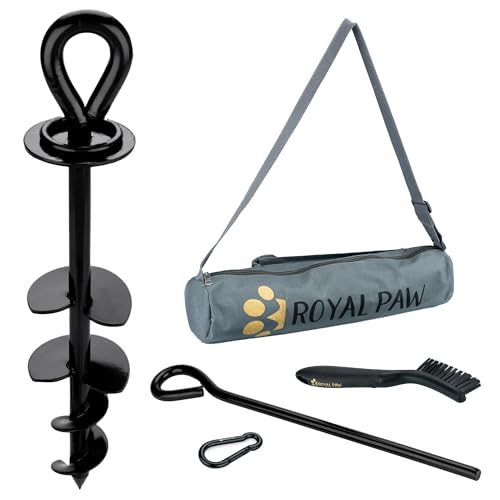
Ground stakes and anchors are the simplest setup. A single point is driven or screwed into the ground, with a fixed-length line or cable clipped to a harness. A corkscrew stake works in average soil for small-to-medium dogs. An auger-style anchor with wider threads holds better in sandy or loose ground. A heavy-duty plate or J-hook anchor is built for large, strong dogs who can otherwise pull a lightweight stake straight out. The right stake is matched to soil type and dog weight, not just picked off a shelf. An undersized stake in dry, sandy soil is one of the most common failure points reported with this kind of tether. For the full breakdown of stake types, installation depth, and how to test hold strength before you trust it, see our ground stakes and anchors guide.
Trolleys and Cables
A dog trolley system solves a different problem than a single stake. Instead of a fixed radius around one point, a trolley system runs a pulley or ring along a cable strung between two anchor points, two trees, two posts, or a post and the house. This gives the dog a long, straight range of movement rather than a circle. It's a common choice for larger yards or for dogs who tend to wind themselves around a single stake. A cable run brings its own risks: line height, overhead obstructions, and the cable's own tangle potential. Full detail is in our trolley systems and cables guide.
Safety and Law
Safety and legal compliance sits underneath both of the above rather than beside them. An outdoor dog tether setup, whether it's a single stake or a full trolley run, needs to be checked against attended-use rules, entanglement risks, and, increasingly, local ordinances that restrict or ban tethering outright. Because this affects every dog tie out cable run regardless of hardware, we've broken it out into its own hub: safety and legal compliance for tethering.
The decision between a single stake and a trolley run usually comes down to three questions. How big and strong is the dog? What's the soil like? How much space do you actually need to cover?
For small and medium dogs on firm soil, a mid-weight corkscrew stake paired with a coated steel cable is usually sufficient for short supervised breaks. Avoid a thin cord or rope, which can fray or snap under a sudden pull. For dogs over roughly 25kg, or any dog with a strong prey drive or a history of lunging at the end of a line, a plate anchor or auger anchor rated for higher pull weights is the safer starting point. A stake that looks secure at rest can still pull free under a hard, sudden lunge.
Soil matters more than most people expect. Sandy, dry, or recently tilled soil holds a stake far more poorly than firm clay or established lawn. The same stake that's rock-solid in one yard can pull loose in another. If you're not sure, test the anchor yourself first. Put your full weight into a hard pull, in the direction the dog is likely to lunge, before you ever clip a dog to it.
Chain versus cable is a smaller but real choice. Cable is lighter and less likely to cause injury if a dog gets tangled in it, but a determined chewer can sometimes work through thin cable coating. Chain resists chewing, but it's heavier, noisier, and carries a higher entanglement injury risk if it wraps around a limb. For most dogs, a coated cable of appropriate gauge is the more welfare-friendly default.
If you need to cover more ground than a single stake allows, whether that's a large dog who paces or a yard where you want the dog to have real room to move, a trolley run is usually the better fit than simply buying a longer line. A very long single-point tether increases both entanglement risk and the chance of building up dangerous momentum before hitting the end of the line.
Get stake sizing right before anything else. Match the stake's rated pull weight to your dog's actual weight and pulling behaviour, not just its size on the shelf, and go up a size whenever the dog is a strong puller or the soil is loose. A stake sized for a calm 15kg dog is not automatically safe for an energetic 15kg dog that lunges hard at squirrels.
Check hardware for a smooth swivel ring, not a raw welded loop. A proper swivel ring lets the line rotate freely as the dog moves, so the cable doesn't kink, twist tight, or fray against a sharp weld point over repeated use. This is a small hardware detail that has an outsized effect on how long a tether lasts and how safely it handles a lunge.
Follow a short setup safety routine every time. Drive or twist the stake to full depth, not part-way, then put your own body weight into a hard pull toward where the dog is likely to lunge before ever clipping a dog to it. Walk the full radius of the line and clear anything the cable could snag on, fence posts, deck railings, garden furniture, low branches. Fit the harness so two fingers slide flat under any strap, with the line attached to the back or chest ring, never a collar. Set out shade and water before you clip the dog on, and stay within sight and earshot for the entire session.
Ground stakes and anchors sit at the affordable end of outdoor gear. A basic corkscrew stake is one of the cheapest pieces of dog equipment you'll buy, a heavy-duty plate anchor or in-ground concrete anchor costs more but is a one-time purchase that outlasts several lightweight stakes. Coated cable is sold by length and gauge, thicker gauge for larger dogs costs more per metre, and a full trolley system with two anchor points costs more upfront than a single stake but covers far more ground. Spending a little more on galvanized hardware and a properly rated harness is cheap insurance against a failure a bargain stake is more likely to produce.
A handful of rules apply no matter which hardware you choose, and they matter more than the hardware itself.
Unattended Tethering, Collar Use and the Non-Negotiable Rules
Never leave a tethered dog unattended. This is the single most important rule in this entire category. A tie-out is for supervised time only, a bathroom break, a bit of fresh air while you're within sight and earshot. It is not a way to leave a dog outside while you run errands or go to work. Unattended tethering is where the overwhelming majority of serious tie-out injuries and deaths occur. It's also the specific practice that most local ordinances are written to restrict.
Entanglement and strangulation risk are the real dangers, not just the tether snapping. A dog that circles a stake repeatedly can wind the line short enough to trap itself against an object, or wrap a limb tightly enough to cut off circulation. Cables that cross fence lines, decking, or furniture create snag points a dog can't free itself from. Keep the tether area clear of obstacles the line can catch on, and check the working length of the setup with the same care you'd give a fence line.
Always use a well-fitted harness, never a collar. A dog that hits the end of a tether at a run, chasing a squirrel or startled by a noise, puts the full force of that stop through whatever the line is attached to. On a collar, that force lands on the throat and can cause tracheal damage, or in the worst cases, be fatal. A properly fitted body harness distributes that same force across the chest and shoulders. This one substitution removes a large share of the injury risk from tethering. Reputable welfare organisations, including the Humane Society's tethering guidance, treat it as a baseline requirement, not an option.
Shade, water, and weather matter every time, even for short stints. A dog on a stake in direct sun with no water available can overheat faster than most owners expect, particularly on hot pavement or in humid conditions. Set the tether zone up with shade and a water bowl within reach before you clip the dog on, not as an afterthought.
A tie-out isn't the right tool for every dog or every situation, and recognising that in advance, as part of genuinely humane use rather than an afterthought, prevents most of the bad outcomes associated with this equipment.
Puppies have less predictable pull patterns, weaker recall, and a higher chance of tangling themselves out of simple inexperience. A young puppy is generally better served by an exercise pen or fully supervised free time than a stake, at least until basic leash manners and settling skills are established.
Reactive or high-prey-drive dogs are more likely to hit the end of the line at speed, whether that's toward a passing dog, a person, a cat, or wildlife. The sudden stop is exactly the scenario that causes the worst tie-out injuries, and a dog that lunges hard and often is a poor candidate regardless of how strong the hardware is.
Extreme weather, very hot pavement, high humidity, freezing temperatures, or storms, makes any tethered stretch riskier than normal, and it's often simpler to skip the tie-out entirely on these days rather than shorten the session and hope it's enough.
Any situation where true supervision isn't possible rules out a tie-out by definition. If you can't commit to staying within sight and earshot for the whole session, the tool isn't appropriate for that moment, even if it's fine on other days.
Tethering law varies enormously by location, and it changes often enough that a rule you read a year ago may no longer be current. Many cities, counties, and states now regulate tethering directly. Some cap the number of consecutive hours a dog can be tied. Some require a minimum tether length or mandate shade and water. A growing number restrict unattended tethering altogether, or ban chain tethers in favour of cable or rope. Some jurisdictions have no specific tethering ordinance at all, but will still act under a general animal cruelty statute or neglect provision if a dog is left tied in unsafe conditions.
Because this varies so much by council, city, and state, treat everything here as general welfare guidance, not legal advice. Always verify the current rules for your specific location before setting up a long-term or repeated tethering arrangement. A quick check with your local animal control office or council website is worth the ten minutes it takes.
Separate from the legal question is the welfare one. Chronic tethering, keeping a dog tied for extended periods as a routine lifestyle rather than an occasional supervised tool, is discouraged by essentially every major animal welfare body, regardless of what local law technically permits. Dogs kept on a permanent or near-permanent tether tend to show higher rates of anxiety, frustration-based aggression, and physical injury than dogs housed with a fence or supervised access. If tethering has become your dog's default outdoor arrangement rather than an occasional tool, our safety and legal compliance guide covers this in more depth, including how to recognise the signs and what to move toward instead.
If you're reaching for a tie-out because you need a way to give your dog outdoor time without direct supervision, it's worth pausing on whether tethering is actually the right tool. A secure backyard fence, even a modest one, or a portable exercise pen for temporary setups like camping or visiting relatives, removes the entanglement and unattended-tether risks entirely and lets the dog move freely rather than in a fixed radius.
For exercise and mental stimulation rather than bathroom breaks, a long-line walk, a 5-10 metre leash used on open ground, always with a harness and always attended, gives a dog much of the freedom of a trolley run with none of the fixed-point entanglement risk. You're moving with the dog rather than leaving it tied. Where possible, supervised off-leash or fenced yard time simply outperforms any tether setup for a dog's wellbeing. A tie-out should be the fallback for short, specific situations, not the daily plan.
Stakes and anchors are the hardware. Trolleys and cables are the layout. Safety and legal compliance is the set of rules that makes either one acceptable to use. Choosing the right stake for your soil and dog size reduces the chance of a sudden pull-out. Choosing cable over chain, and keeping the run clear of snag points, reduces entanglement risk. Following attended-use and local-law guidance is what keeps a genuinely useful short-term tool from becoming a welfare or legal problem. None of these three pieces works well in isolation. A strong anchor on a poorly routed cable is still dangerous, and a perfectly laid-out trolley run is still a problem if the dog is left on it unattended for hours.
Is it ever okay to leave a dog on a tie-out overnight?
No. Unattended tethering, especially overnight, is where most serious tie-out injuries occur, and it's restricted or banned outright in many areas.
What size dog tie out stake do I need for a medium-sized dog?
It depends more on soil type and pull strength than weight alone. A corkscrew stake that holds firmly in clay can pull straight out of sandy soil. Full stake sizing guidance is in the ground stakes and anchors guide.
What's the difference between a tie-out trolley system and a single stake?
A single stake gives a dog a fixed circular range around one point. A trolley or zip-line runs a pulley along a cable between two anchor points instead, giving a long straight range better suited to larger yards or dogs that wind themselves around a single point.
How long should a dog's tie-out cable be?
Long enough to move, lie down, and reach shade and water comfortably, but not so long it builds dangerous speed before hitting the end or reaches a fence line or road. Match length to the cleared space you've actually walked and checked.
Can I leave my dog on a tie-out unattended?
No. Supervision is the single non-negotiable rule. Unattended time is where most serious injuries occur, and many ordinances specifically restrict or ban it.
Should I use a chain, cable, or rope for a tie-out?
Coated cable is generally the better default, lighter than chain, less prone to fraying than rope, with lower entanglement risk than either. Details are in the trolley systems and cables guide.
Can I use a collar instead of a harness for tethering?
No. A hard stop against a collar puts the full force of the lunge through the throat. A harness with a proper swivel ring distributes that force safely across the chest.
Is a tie-out a good alternative to a backyard fence or playpen?
Only as a short-term, supervised stand-in, not a long-term substitute. A fence or portable exercise pen removes the entanglement and unattended risks entirely, and either is the better choice whenever it's available.
When is a tie-out not appropriate for a dog?
Puppies, reactive or high-prey-drive dogs, extreme weather, and any situation where genuine supervision isn't possible are all reasons to use an exercise pen, fenced yard, or long-line walk instead for humane use.
Do local laws really restrict how I can tether my dog?
In many areas, yes, under a dedicated tethering ordinance or a general animal cruelty statute. Rules on length, duration, and attended use vary by city, county, and state. Always verify current rules locally, this page is general information, not legal advice.