


How to Choose a No-Pull Dog Harness
A no-pull harness is one of the few pieces of dog gear that changes a walk immediately, but only if you understand what it actually does. The phrase "no-pull" is marketing shorthand, not a magic switch. No harness stops a dog from wanting to pull; the good ones simply change the physics so pulling stops being rewarding and stays comfortable and safe. Everything below is drawn from aggregated verified owner reviews and manufacturer specifications, not hands-on lab testing, so treat it as a buyer's framework rather than a fitting appointment.
Front-clip vs back-clip vs head-halter, the three mechanisms
Back-clip harnesses attach the lead between the shoulder blades. They are the most comfortable and the easiest to fit, and they keep pressure off the throat entirely, which is exactly why they suit small dogs, puppies and dogs with tracheal sensitivity. Their weakness is leverage: a dog leaning into a back-clip harness is in the same position as a sled dog in a pulling rig, so for a committed puller a back-clip alone does little to discourage the behaviour.
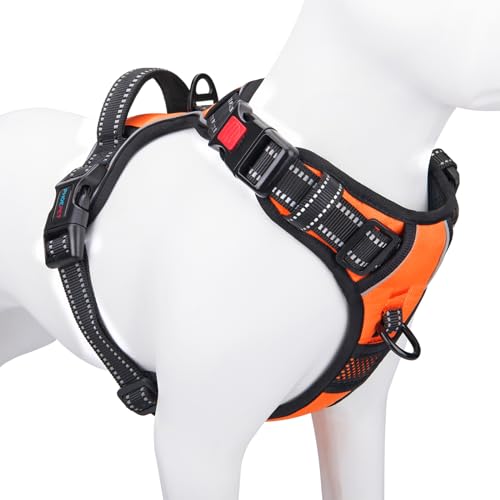
Front-clip harnesses attach at the centre of the chest. When the dog surges forward, the lead turns the dog's body back toward you instead of letting it power straight ahead. This is the mechanism that earns the "no-pull" label: it redirects momentum rather than resisting it. Front-clip designs like the PetSafe Easy Walk add a martingale chest loop that gently tightens across the chest, never the neck, to add a mild, self-releasing cue. Dual-clip harnesses (the rabbitgoo, tobeDRI and PoyPet picks) give you both rings so you can train on the front and relax on the back.
Head-halters are a separate category that steers from the muzzle. They offer the most control of all but require gradual desensitisation and are easy to misuse, which is why most owners start with a front-clip harness first. If you do move to a head-halter for a very strong or reactive dog, introduce it slowly over several short sessions with treats, and never jerk the lead, the leverage on the head is significant. For the majority of pullers, a well-fitted front-clip harness is the sensible first step and often the only tool you will need.
Fit and measuring, the part that actually matters
More harnesses fail because of fit than because of design. Two measurements decide everything: the girth (the circumference of the chest just behind the front legs, at the widest point of the ribcage) and the neck/base of the neck where the harness sits. Measure with a soft tape while the dog is standing, and if a dog falls between two sizes, size up only if the straps still cinch small enough to pass the two-finger test, you should be able to slide two fingers flat under any strap, but no more.
The single most common escape scenario is a harness left loose around the neck and shoulders. A dog that backs up hard can pivot and reverse straight out of an under-adjusted harness. Independent neck and chest adjustment, four points on the rabbitgoo, three buckles on the PoyPet, exists precisely so you can close those gaps. Escape-proofing is a fitting habit, not a product feature. Re-check the fit every few weeks, too: dogs gain and lose weight, coats grow out after grooming, and straps loosen with use, so a harness that fitted perfectly in spring may be an escape risk by autumn. For a known escape artist, look for a design with an extra belly strap or a third point of contact, which removes the geometry a dog uses to reverse out.
Materials, padding and sizing to breed
For everyday walkers, a padded mesh or Oxford body spreads pressure and stays comfortable on shorter walks. For hiking, working dogs and heavy pullers, ruggedised nylon with load-bearing straps and metal hardware, the Auroth tactical style, lasts far longer and inspires more confidence under load, at the cost of weight and heat. Small and brachycephalic breeds do better in light air-mesh step-in vests that avoid any over-the-head handling and keep all pressure off the windpipe.
Breed shape matters as much as size. Deep-chested dogs (greyhounds, boxers) tend to slip narrow harnesses forward toward the shoulders and need a design that sits well behind the legs. Barrel-chested and thick-necked breeds (bulldogs, staffies) need generous girth adjustment and often benefit from a step-in style. A giant breed that pulls hard should be matched to metal rings and a reinforced handle rather than a plastic-buckled mesh vest. Puppies are a special case: they change shape fast, so buy a well-adjustable harness you expect to replace as they grow rather than sizing up and hoping they grow into it, a loose puppy harness is both an escape risk and a chafing risk.
Pay attention to how a harness is put on, as well. Over-the-head styles are quick once a dog is used to them but can spook nervous or noise-sensitive dogs; step-in styles avoid the head entirely; and fully unbuckling harnesses are the easiest for dogs that dislike being handled at all. The right fitting style is the one your specific dog tolerates calmly, because a harness that turns every walk's start into a wrestling match rarely stays in use.
Safety, what a no-pull design should and shouldn't do
A well-designed no-pull harness protects the throat by moving load to the chest and shoulders, which is a genuine welfare improvement over a flat collar for any dog that pulls. What it should never do is choke, ride up into the armpits and chafe, or apply sharp pressure to a single point. If a harness rubs the front legs raw or the dog freezes and refuses to walk, the fit or the style is wrong for that body, not a sign to tighten harder.
Finally, keep expectations honest. The harness is a management tool that makes pulling less effective and less rewarding; lasting change comes from pairing it with loose-lead training and rewarding the dog for walking beside you. Buy for your dog's body and pulling strength first, and let the award categories below narrow it from there.