
Best No-Pull Dog Harness
Best No-Pull Dog Harness, ranked from aggregated owner ratings and reviews, not first-hand testing. Real pros, cons, and who each pick is best for.


Our Top 3 Picks
Quick Comparison
| Product | Best for | Buy | |
|---|---|---|---|
| rabbitgoo No-Pull Dog Harness | Best Overall | See Amazon | View |
| tobeDRI No-Pull Dog Harness | Best Budget | See Amazon | View |
| No-Pull Reflective Front-Clip Harness | Best for Strong Pullers | See Amazon | View |
| PetSafe Easy Walk Harness | Best Front-Clip Trainer | See Amazon | View |
| Auroth Tactical Dog Harness | Best Tactical / Adventure | See Amazon | View |
| Voyager Step-In Air Harness | Best for Small Dogs | See Amazon | View |
How We Chose
We built this shortlist from a pool of the most popular no-pull harnesses on the market, then ranked them on the criteria that actually predict a good walk. To be clear about our method: these are not hands-on lab tests. Our assessments are based on aggregated verified owner reviews and published manufacturer specifications, cross-checked so that a high rating is backed by a large enough review base to be meaningful.
Verified owner satisfaction and review depth. A strong rating from a small number of buyers is far less reliable than the same rating earned across a very large owner base. We weighted both the star rating and the size of the verified review base, which is why the rabbitgoo, the most popular harness in the pool, anchors the list, and why every pick here carries a substantial, consistent track record rather than a thin or inflated one.
Anti-pull mechanism that holds up. We prioritised harnesses with a genuine front-clip attachment or a martingale chest loop, because those are the designs that redirect a pulling dog rather than simply resisting it. Back-clip-only vests earned their places on comfort and throat protection for small dogs, not on pull control, and we say so plainly in each review.
Fit range and escape resistance. Because most harness failures are fit failures, we favoured designs with independent neck and chest adjustment, four-point strapping or multi-buckle systems, that let owners close the gaps a determined dog uses to back out.
Materials and hardware matched to load. We looked for padding and breathability on everyday walkers, and for load-bearing nylon plus metal rings on the picks aimed at strong pullers and adventure use. Plastic hardware is acceptable for typical dogs but was noted honestly as a limitation for the most powerful chewers.
Honest cons on every product. No harness here is perfect, and each review lists at least one real drawback, escape risk, heat, plastic buckles, a learning curve or back-clip-only limits, so you can rule a product out for the right reason.
What we deliberately left out. We did not quote prices or exact measurements, because both move constantly and vary by size and colourway, always confirm the current figures and the size chart on the product page against your own dog's girth before buying. We also avoided ranking a comfort vest above a training harness or vice versa; they solve different problems, and forcing them into a single league table would mislead more than it helps.
We deliberately spread the awards, Best Overall, Best Budget, Best for Strong Pullers, Best Front-Clip Trainer, Best Tactical/Adventure and Best for Small Dogs, because the right harness depends far more on your individual dog than on any single "best" ranking.
Full Ranking, Reviewed

Best for Everyday walkers who want a dual-clip harness that fits most medium-to-large breeds
- Two leash attachment points, a front chest ring for anti-pull steering and a back ring for relaxed walks
- Four adjustment straps (two neck, two chest) so the fit can be dialled in independently around girth and shoulders
- Padded, breathable body panel with reflective stitching for low-light visibility
- Top-mounted grab handle for close control or lifting over obstacles
- Enormous verified-owner track record, the most popular harness in this pool by a wide margin
- Front-clip option gives genuine steering leverage without a choke effect on the throat
- Four-point adjustment makes it forgiving across body shapes and coat thicknesses
- Owner reviews repeatedly flag that determined dogs can back out of it if the neck straps are left too loose
- The buckles are plastic, fine for most pullers but not built for the very strongest, most destructive chewers
Verdict: Based on aggregated verified owner reviews and manufacturer specs, this is the safest default pick: a well-padded dual-clip harness with the deepest satisfaction record of anything in the category. Measure carefully and keep the neck straps snug and it handles the vast majority of pullers.

Best for Cost-conscious owners who want a front-clip harness and a lead in one purchase
- Includes a heavy-duty 5ft leash in the box, so it doubles as a starter walking kit
- Front and back D-rings for switching between anti-pull and standard walking modes
- Oxford-fabric body with reflective strips for durability and roadside visibility
- Four adjustment points for a customised chest and neck fit
- Strong value, a bundled lead plus a front-clip harness at an entry-level position
- High owner rating across a large review base signals consistent real-world satisfaction
- Oxford material holds up better to abrasion than thin mesh vests
- The included lead is functional rather than premium, some owners upgrade it later
- Runs on the firmer side, so very short-coated or sensitive dogs may want extra padding
Verdict: Based on aggregated verified owner reviews and manufacturer specs, this is the smart low-cost entry: you get a durable Oxford front-clip harness and a usable lead together. The hardware is honest rather than luxurious, but the satisfaction record is among the highest in the pool.
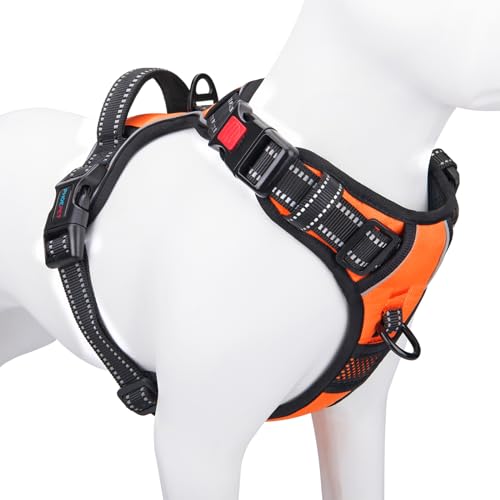
Best for Dogs that lean hard into the lead and need a secure, escape-resistant front-clip setup
- Front chest ring plus a rear ring, two metal attachment points rated for real pulling force
- Three buckles allow the harness to be stepped into or fastened without lifting it over the head
- Padded vest body with a reinforced top handle for immediate close control
- Reflective webbing woven through the straps for night walks
- Metal leash rings inspire more confidence than plastic clips under heavy load
- Three-buckle design makes it easy to get on anxious or wriggly dogs
- Front-clip geometry redirects a lunging dog back toward you rather than letting it drag ahead
- The multi-buckle system takes a little practice to fit correctly the first few times
- Padded vest style runs warm, so it is less ideal for heavy exertion in hot climates
Verdict: Based on aggregated verified owner reviews and manufacturer specs, this is the pick for committed pullers: metal rings, a solid handle and a true front-clip point give you the leverage to interrupt lunging safely. Expect a short learning curve on the buckles.
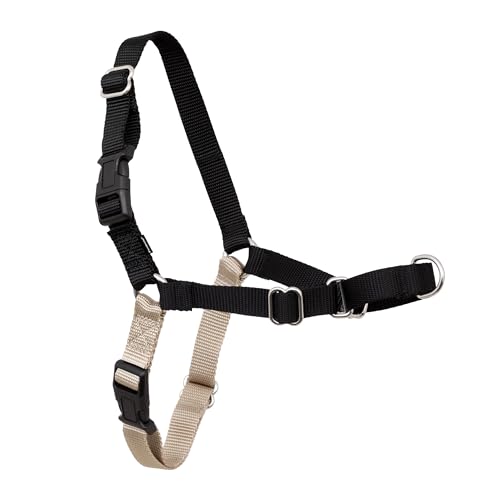
Best for Owners training a dog out of pulling who want a proven front-attachment steering design
- Patented martingale chest loop that applies gentle, gradual shoulder pressure when the dog pulls forward
- Front-only leash attachment sits on the chest to turn the dog rather than reward forward force
- Quick-snap shoulder and belly buckles for fast on-and-off
- Colour-matched straps to help identify the belly strap during fitting
- A long-standing, vet- and trainer-recommended front-clip design with a clear anti-pull mechanism
- The martingale loop tightens gently across the chest, not the throat, so it avoids choking
- Genuinely reduces pulling for many dogs from the first few walks
- Back-clip only walkers get nothing here, it is a front-attachment harness by design
- Owner reviews note it can rub or slip toward the shoulders on deep-chested or lean breeds without careful adjustment
Verdict: Based on aggregated verified owner reviews and manufacturer specs, this is the dedicated training tool: its martingale chest loop is one of the most established humane anti-pull mechanisms available. It is not a general-purpose harness, but for teaching loose-lead walking it earns its place.

Best for Large, powerful dogs on hikes and working sessions where control and durability matter most
- Heavy-duty nylon construction with wide load-bearing straps for strong, large-breed dogs
- MOLLE webbing panels for attaching pouches, patches or gear on longer outings
- Reinforced control handle over the shoulders for immediate hands-on restraint
- Adjustable straps with reflective accents and a sturdy metal front leash ring
- Built tougher than everyday mesh vests, suits pulling, hiking and training work
- Top-rated in this pool for owner satisfaction, with a wide, load-spreading fit
- The rugged handle gives excellent close control on reactive or high-drive dogs
- Heavier and warmer than a lightweight walking harness, which is overkill for gentle strollers
- The bulk and straps take longer to fit and adjust than a simple step-in vest
Verdict: Based on aggregated verified owner reviews and manufacturer specs, this is the adventure and working pick: durable webbing, a strong handle and MOLLE utility make it the harness for demanding outdoor use with a big dog. It is more harness than a casual walker needs.

Best for Small and toy breeds that need a lightweight, low-pressure step-in vest
- Step-in design, the dog places two front legs in, then it fastens over the back with no over-the-head handling
- Breathable air-mesh body that spreads pressure across the chest rather than the neck
- Reflective bands on both sides for visibility on evening walks
- Back-clip attachment sized and weighted for smaller frames
- Gentle, wide mesh distributes force well for delicate necks and windpipes
- Step-in fitting suits small dogs that dislike anything pulled over the head
- Light and cool, comfortable for short-legged breeds in warm weather
- Back-clip only, it offers comfort and throat protection, not front-clip anti-pull steering
- Air-mesh is less rugged than tactical nylon and is not intended for strong, determined pullers
Verdict: Based on aggregated verified owner reviews and manufacturer specs, this is the small-dog choice: a soft step-in vest that protects a fragile trachea and is easy to fit. Just note it is a comfort harness, for a hard-pulling small dog, pair it with front-clip training instead.


Frequently Asked Questions
Do no-pull harnesses actually stop a dog from pulling?
Not on their own. A no-pull harness, especially a front-clip or martingale design, changes the physics so that pulling turns the dog back toward you instead of letting it power ahead, which makes pulling less rewarding and far more comfortable than a collar. It is a management tool, though, not a cure. Lasting change comes from pairing the harness with loose-lead training and rewarding your dog for walking beside you.
Is a front-clip or back-clip harness better for pulling?
For pulling, front-clip wins. Attaching the lead at the chest redirects a surging dog's momentum sideways and back toward you, which is the mechanism that earns the 'no-pull' label. Back-clip attachments are more comfortable and better for small or throat-sensitive dogs, but they give a strong puller the same leverage a sled dog uses. Dual-clip harnesses let you train on the front ring and switch to the back for relaxed walks.
How do I stop my dog escaping from its harness?
Escapes are almost always a fitting problem, not a product fault. The usual scenario is a harness left too loose around the neck and shoulders, letting the dog reverse and pivot out. Measure the chest girth just behind the front legs, fit the harness so you can slide only two fingers flat under any strap, and adjust the neck and chest straps independently. If your dog is a committed escape artist, choose a design with multiple adjustment points and keep the neck straps snug.
What harness is safest for a small dog?
For small and toy breeds, a lightweight step-in air-mesh vest with a back-clip attachment is usually safest, because it keeps all pressure off the delicate windpipe and spreads load across the chest. Step-in designs also avoid pulling anything over the head, which many small dogs dislike. If a small dog pulls hard, add gentle front-clip training rather than relying on a comfort vest alone to control the behaviour.