
Best Dog Collars
Best Dog Collars, ranked from aggregated owner ratings and reviews, not first-hand testing. Real pros, cons, and who each pick is best for.

Our Top 3 Picks
Quick Comparison
| Product | Best for | Buy | |
|---|---|---|---|
| Joytale Reflective Neoprene Padded Dog Collar | Best Overall | See Amazon | View |
| Country Brook Petz Premium Nylon Collar with Metal Buckle | Best Value | See Amazon | View |
| Country Brook Petz Martingale Collar | Best for Training | See Amazon | View |
| BSEEN LED USB Rechargeable Light-Up Collar | Best for Night Safety | See Amazon | View |
| GoTags Personalized Embroidered Collar | Best for ID | See Amazon | View |
| DAGANXI Tactical Nylon Collar with Control Handle | Best for Strong Pullers | See Amazon | View |
How to buy the right dog collar
Start with the tape measure, not the colour. Measure around the base of your dog's neck and match that number to the size chart for the exact collar you are considering, because sizing is not consistent between brands. Once it is on, apply the two-finger rule: two fingers should slide flat between collar and neck, no more and no fewer. Too loose and the dog can slip out near traffic; too tight and it rubs. Re-check a growing puppy every couple of weeks.
Pick a material for your dog's life, not the photo. Plain nylon is the cheap, light, do-everything default. Neoprene-lined nylon adds padding for dogs that pull or have short coats, at the cost of drying more slowly after a swim. Leather looks smart and lasts if you keep it out of constant water; biothane is the fully waterproof, wipe-clean option for dogs that swim and roll in things. Nylon is the safe starting point for most people.
Choose the buckle to match the dog's strength. A side-release plastic clip is quick and fine for average dogs. A metal buckle is stronger and lasts longer, which matters for large or powerful dogs that throw their weight into the lead.
Add visibility and ID if your walks or your dog need them. Reflective stitching woven into the webbing is a permanent, no-cost-later safety feature for low-light walks; an LED band goes further on truly dark roads but is best layered over your main collar. For identification, an embroidered collar or engraved name plate keeps a readable phone number on the dog at all times and backs up the microchip. Remember that personalised collars usually cannot be returned, so measure and proofread before you order.
Know when to skip the collar for walking. A flat collar suits most dogs, and a martingale is the answer for narrow-headed breeds that reverse out of a normal collar, used only while supervised and on-lead. But if your dog pulls hard and constantly, or is a flat-faced breed like a Pug or French Bulldog, or has any diagnosed neck or airway problem, move the lead to a front-clip harness and let the collar simply carry the ID.
Match the width to the dog, and buy a little room to adjust. A wide band spreads pressure and suits a large, strong dog, while a thin band is lighter and more comfortable on a toy breed; a collar that is too wide for a small neck simply gets in the way. Wherever the size chart puts your dog near the top or bottom of a range, pick the collar with the most adjustment left so you can fine-tune the fit and allow for a growing puppy or a seasonal coat change.
Finally, use the collar sensibly once it is on. Take the collar off, or use a breakaway design, when your dog is crated or left alone, because collars and tags can snag on wire, fences, and vents and are a genuine hazard unsupervised. Getting the fit, material, and type right is most of the job, and handling the collar with a little care does the rest.
Full Ranking, Reviewed

Best for Everyday walks for medium and large dogs that need comfort and low-light visibility
- Nylon webbing with a soft neoprene lining across the inside of the band
- Reflective stitching woven along the full length for low-light visibility
- Metal D-ring and a side-release plastic buckle
- Sold in several neck-size ranges and multiple colours
- The padded lining reduces rubbing on dogs that pull or have short coats
- Reflective thread genuinely catches car headlights at night, unlike printed-on strips
- One of the most widely owned everyday collars on Amazon, so sizing feedback is easy to sanity-check
- The plastic buckle is convenient but not as strong as a metal one for a determined puller
- Neoprene padding holds water and takes longer to dry after swimming or rain
Verdict: A well-padded, genuinely reflective everyday collar that suits the widest range of dogs. It is the one to buy if you want a single collar that does most things well rather than one that specialises.

Best for Owners who want a plain, tough nylon collar with a metal buckle at a low price
- Single-layer high-density nylon webbing
- Metal buckle rather than a plastic clip
- Welded steel D-ring for the lead and tags
- Offered in 30+ colours and several widths and sizes
- Metal buckle holds up better than plastic clips over years of use
- Very inexpensive, so keeping a spare or sizing up as a puppy grows is painless
- Simple flat design with nothing to trap dirt or hold water
- No padding, so it can rub a heavy puller with a short coat
- A metal buckle is fiddlier to fasten one-handed than a quick-release clip
Verdict: A no-frills workhorse. If you do not need padding or reflectivity and just want a durable flat collar with a proper metal buckle, this is hard to beat on price.

Best for Dogs that back out of a flat collar, and gentle no-choke lead training
- Martingale (limited-slip) design with a smaller control loop
- No-buckle style that slips over the head
- Tightens only to a set point, so it will not fully choke
- Available in a range of sizes and colours
- Stops slip-prone breeds like Greyhounds and Whippets from reversing out of the collar
- Snugs up under tension then releases, which is gentler than a slip lead
- Lies flat and comfortable when the dog is not pulling
- Because it tightens, it should never be left on an unsupervised dog
- You must measure the head as well as the neck, or it will slip off or not fit
Verdict: The right tool for escape artists and for owners who want a no-choke way to discourage pulling. It is a supervised, on-lead collar, not an all-day tag collar.
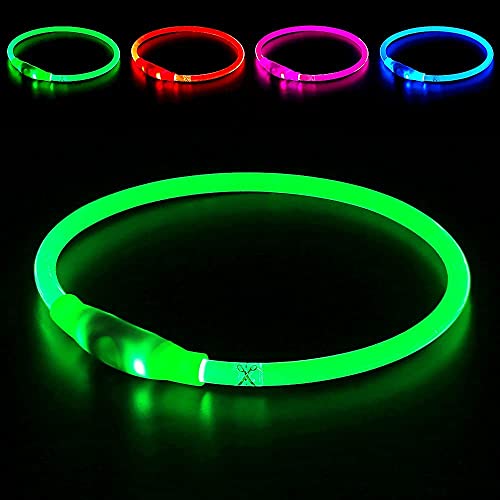
Best for Early-morning and after-dark walks where you want the dog to be seen from a distance
- Silicone band with an embedded LED strip
- USB rechargeable rather than replaceable batteries
- Steady and flashing light modes
- Cuttable to size for a custom neck fit
- Active light makes the dog visible far earlier than passive reflective stitching
- Rechargeable, so there is no ongoing battery cost
- Being seen from all angles is a real safety gain on unlit roads
- This is a visibility band, not a strength collar, so it is best worn alongside your main walking collar or harness
- The LED and charging port mean it is not as rugged or as water-tolerant as a plain nylon collar
Verdict: The best pick purely for being seen in the dark. Treat it as a safety add-on layered over your everyday collar or harness rather than the thing you clip the lead to.

Best for Owners who want the dog's name and phone number on the collar instead of a jingling tag
- Nylon webbing with the pet name and phone number embroidered directly in
- Side-release buckle and a metal D-ring
- Several colours and neck sizes
- Details are stitched in rather than printed
- Contact details are always on the collar, with no tag to fall off or wear blank
- Embroidery is silent, so no metal tag jingle
- A backup to microchipping that a member of the public can read instantly
- Personalised items usually cannot be returned, so you must get the size and text right first time
- Embroidery thread can fade or fray with years of heavy wear
Verdict: The simplest way to keep readable contact details on your dog at all times. Pair it with a microchip rather than treating either one as the whole plan.

Best for Large, powerful dogs where you occasionally need close, hands-on control
- Thick, wide tactical nylon webbing
- Integrated grab handle above the neck
- Heavy metal buckle rated for larger dogs
- Adjustable across a wide neck range
- The control handle lets you take direct hold near a road, vet, or a sudden hazard
- Wide band spreads pressure better than a thin collar on a heavy dog
- Metal buckle and thick webbing feel built for strong breeds
- Lowest star rating of this group at 4.4, with some reports of buckle and stitching wear under hard use
- For a dog that pulls constantly, a front-clip harness protects the neck better than any collar
Verdict: A sturdy collar for handlers of big, strong dogs who value a grab handle for close control. If the pulling is constant rather than occasional, move the lead to a harness and use this for handling only.

Frequently Asked Questions
How tight should my dog's collar be?
Use the two-finger rule. You should be able to slide two fingers flat between the collar and your dog's neck, but no more. If the collar pulls over the ears with a firm tug it is too loose and the dog can back out of it; if you cannot get two fingers underneath it is too tight and will rub. Re-check the fit often on a growing puppy, because a collar that fit a month ago can quickly become too tight.
Is a collar or a harness better for a dog that pulls?
For a dog that pulls hard and constantly, a front-clip harness is better and safer. Every lunge on a collar lands on the throat, which over time is linked to strain on the neck and airway, while a harness spreads that pressure across the chest and gives you more steering control. The same applies to flat-faced breeds and any dog with a neck or airway condition. In those cases, clip the lead to the harness and let the collar carry only the ID and tags.
What is a martingale collar and does my dog need one?
A martingale is a limited-slip collar with a smaller control loop that snugs up under tension and then stops at a preset point, so it tightens enough to prevent escape without fully choking. It is ideal for narrow-headed breeds like Greyhounds and Whippets that can reverse out of a flat collar. Because it tightens, it should only be used while the dog is supervised and on-lead, never left on all day.
Should I leave my dog's collar on all the time?
For walks and supervised time, a well-fitted flat collar with ID is fine. But collars and tags can snag on crate wires, fences, vents, or another dog's teeth during play, and a panicked dog can injure itself trying to get free. The safest habit is to remove the collar, or use a breakaway safety collar, whenever your dog is crated or left alone. A martingale in particular should always come off when you are not there to supervise.