Ground Stakes & Anchors for Dogs
Comprehensive technical analysis of material density, anatomical weight distribution, Indentation Load Deflection (ILD) thresholds, and veterinary standards for ground stakes & anchors.

Recommended Products
See the full ranking →

Ground stakes and anchors are the simplest way to give a dog safe, supervised outdoor time without a fence. Done right, a ground stake gives your dog room to sniff, stretch, and sunbathe. Done wrong, it becomes a genuine welfare and injury risk. This guide walks through the types of stakes and anchors available, how to match one to your soil and your dog, and how to use one safely.
Most tie-out stakes fall into a few broad categories:
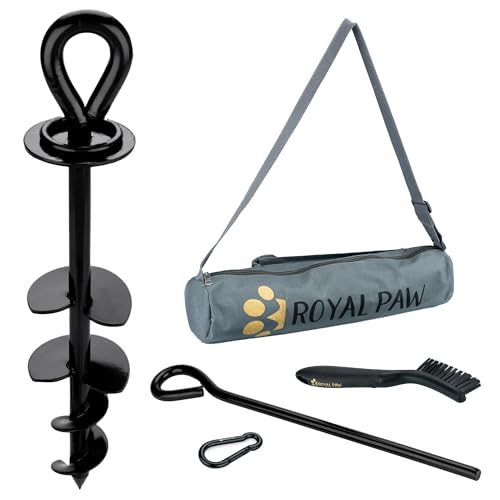
- Corkscrew (auger) stakes, a spiral of galvanized steel that twists into the ground like a giant screw. These bite into soil well and resist being pulled straight up, which is why they're the most common choice for tie-outs.
- Straight spike stakes, a single rod driven straight down with a mallet. Cheaper and easier to install, but they pull out of loose or wet soil far more easily than a corkscrew design.
- Plate or auger combination anchors, a corkscrew stake with a flat plate near the top that adds extra resistance against sideways pulling. Better suited to strong or persistent pullers.
- In-ground concrete anchors, a buried eye-bolt or ring set in a small pour of concrete. Permanent, very strong, and the best option for a dog that regularly tests the limits of lighter stakes.
- Portable weighted anchors, a heavy base (often filled with sand or water) with an attachment ring on top, used where digging isn't possible, such as on a deck, driveway, or campsite.
Soil type has a bigger effect on holding power than most people expect, and a stake that's perfectly safe in one yard can pull loose in another.
- Sandy or loose soil drains fast and offers little resistance, so a corkscrew stake can work its way loose over repeated pulling. Go up a size, choose a plate-style anchor, or set a concrete anchor instead.
- Clay or compacted soil holds a corkscrew stake very well once it's fully twisted in, but can be hard to install, resist the urge to hammer it in partway, since a shallow stake has far less holding power.
- Rocky ground can stop a corkscrew stake from reaching full depth. If you hit rock before the stake is fully seated, relocate rather than leaving it half-in.
- Wet, waterlogged, or frequently watered lawn loses holding strength when saturated. A stake that held firm in dry weather can pull free after heavy rain, so recheck it after wet weather rather than assuming it's still secure.
The stake itself is only half the equation; the other half is whether it can handle your dog's actual pulling force, not just their weight on the label.
- Small, calm dogs can usually be held safely by a standard corkscrew stake rated for their weight.
- Medium and large dogs need a stake rated well above their body weight, since a sudden lunge or a startled bolt generates far more force than steady walking.
- Strong pullers, diggers, or dogs prone to bolting at loud noises (thunderstorms, fireworks, trucks) are the group most likely to pull a stake loose or injure themselves trying. For these dogs, a concrete-set anchor or a heavy-duty plate anchor is a safer investment than a light corkscrew stake, and honestly, supervised leash time or a secured yard is often the better choice altogether.
- Puppies should not be tied out on a stake at all, they lack the size and coordination to manage sudden pulls safely, and unsupervised tethering is especially risky for young dogs.
A stake that's the right type and size still needs to be used correctly:
- Twist it in fully, checking that it doesn't wobble or lift when you pull hard on the ring by hand before clipping your dog on.
- Use a short, sturdy tie-out line rather than a retractable leash, retractable cords can snap, tangle, or cut if pulled hard, and they're not designed for unsupervised tethering.
- Attach to a well-fitted harness where possible, not just a collar, to reduce strain on the neck if your dog hits the end of the line at speed.
- Check the swivel and clips regularly for rust, cracking, or stiffness, and replace hardware at the first sign of wear.
- Clear the tether radius of furniture, fencing, garden edging, and anything a line could wrap around, and remember that dogs will find the one obstacle you missed.
- Provide shade, water, and a line long enough to move out of direct sun, especially in warmer months.
- Recheck the stake position after rain, digging, or a hard pull-test, since ground conditions change.
No stake, however well installed, replaces supervision. Ground stakes are a tool for short, watched outdoor sessions, not a way to leave a dog unattended in the yard for extended periods. The next guide in this section, on trolley and cable systems, and the one after it on the legal and welfare side of tethering, both build on this same principle: the hardware only does its job when a person is genuinely keeping an eye on the dog at the other end of it.
Go Deeper
Detailed companion guides for ground stakes & anchors.
Choosing a Tie-Out Stake by Dog Size, Soil Type, and Pull Strength
How corkscrew, auger, and weighted stakes grip different soils, why rated pull strength differs from a lunge, and how to match stake and line to your dog.
Tie-Out Safety, How to Use a Stake Without Risking Your Dog
Why a tethered dog needs constant supervision, how entanglement causes strangulation, why harnesses beat collars, and the safety rules for tie-out use.