


Match the stake to your soil, not just your dog
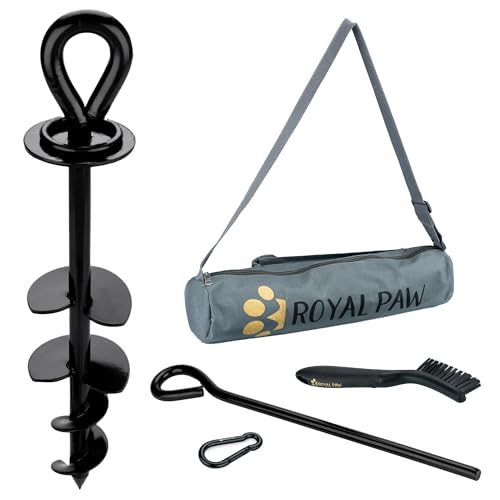
The right ground stake depends as much on your soil as on your dog. A straight spike stake can work in firm, compacted soil, but in sandy soil, loose garden beds, or anywhere the ground stays soft after rain, it can work loose with surprisingly little effort from the dog. A corkscrew (auger) stake, twisted deep into the ground, holds far better in most conditions because it resists being pulled straight up the way a spike does. If your yard has clay soil that turns rock-hard in summer, you may need to soften a starting hole slightly so the auger can be driven to full depth rather than sitting shallow.
Size the stake to your dog's real pulling force, not their standing weight
A common mistake is choosing a ground stake based on a dog's resting weight. The force generated when a large dog lunges or runs to the end of a cable is many times greater than their static body weight, so buy an anchor rated well above what your dog weighs, manufacturers list a maximum-dog-weight rating for exactly this reason. For a strong or high-energy large dog, size up again rather than trusting a stake rated right at the edge of their weight.
Depth and angle matter as much as size
A stake driven in at an angle, or only partway, gives a fraction of the holding power of one sunk fully and vertically (or angled slightly away from the direction of pull, for corkscrew designs). Push or twist it in until the top ring sits close to ground level, and give it a firm test pull in the direction your dog is likely to run before you ever clip a leash to it. If it shifts at all under your own hand, it will not hold a determined dog.
Small dogs still need a secure anchor
It's tempting to assume a small or light dog needs only a light-duty stake, but a small dog can still generate a sharp jolt of force, and a stake that pulls free is just as much a hazard, an escaped dog on a trailing cable is a real danger around roads and other animals. Choose based on temperament and energy as well as size.
Checking the anchor over time
Whatever stake you choose, ground conditions change, rain loosens soil, frost can heave a shallow anchor, and repeated pulling gradually widens the hole around it. Get in the habit of checking that the ground stake is still firmly seated each time you use it, rather than treating it as permanently installed.
Beyond raw pull strength, think about how your dog tends to move on a tie-out. A dog that paces the radius steadily puts a different, more constant load on the anchor than one that mostly lies still and only lunges occasionally at passing distractions, the second pattern generates sharper, more sudden peak forces even if the average pull is lower. If your dog is the lunging type, err toward a heavier-rated stake and a shorter cable rather than relying on the stake's rating alone.
Before the first real use, drive the stake in fully, clip on a spare lead, and have a second person apply a hard, sudden pull from the direction your dog is likely to run, not just a steady tug. If the stake shifts, lifts, or the ground visibly gives way, that's a sign to move up to a larger auger stake or a heavier-duty ground stake rather than trusting it on the strength of the packaging alone.