



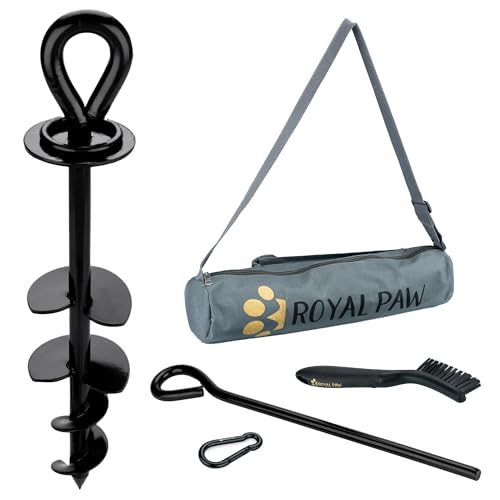
When is a tie-out not appropriate, puppies still learning boundaries
A young puppy hasn't learned how a tie-out line behaves, and puppies are especially prone to winding a cable around their legs or a nearby object while playing, without the coordination to work themselves free. A puppy is also more likely to panic and lunge repeatedly against the line rather than settle, which raises the risk of a neck injury. Puppies are generally better managed with direct supervision on a regular leash, or inside a secure pen, until they're mature enough to understand the setup.
Dogs with a neck injury history
Any dog with a neck injury history, a known trachea problem, or a collapsing trachea is a poor candidate for a tie-out, since the whole risk profile of tethering centres on sudden force landing on the neck if a collar is used, or even a harness during a hard lunge. For these dogs, the safer choice is to skip tethering entirely rather than try to manage the risk down.
Anxious dogs and dogs that react to strangers passing
An anxious dog, a fearful dog, or a reactive dog that responds to other animals, strangers passing, or noise is a bad fit for a tie-out, because tethering removes their ability to retreat from whatever is triggering them. A dog that would normally back away from strangers passing or another dog approaching instead becomes stuck at the end of a line, which can escalate a mildly stressed reaction into a defensive or aggressive dog response.
New dogs in unfamiliar yards
A new dog in an unfamiliar yard, a rental, a friend's place, a campsite, doesn't yet know the space and is more likely to bolt against the line in surprise, or fail to notice an obstacle it would normally avoid at home. Introduce a tie-out gradually in a new location, starting with close supervision, rather than assuming it will go the same way it does in a familiar backyard.
A tie-out is also not appropriate in extreme heat, cold, or storms, since a tethered dog has limited ability to reach shelter compared with a dog in a fenced yard with a covered area. And regardless of the dog, a tie-out is never appropriate for genuinely unattended time, that's true for every dog, not just the higher-risk cases above.
When in doubt, choose a fence alternative instead
If your dog fits several of these categories, or you're simply unsure, a secure fenced area or a portable exercise pen is the safer fence alternative to a tie-out and sidesteps the risk entirely, worth the extra setup effort.
A dog recovering from surgery, an illness, or any condition affecting balance or mobility is another poor fit for a tie-out. Reduced coordination makes it harder for a dog to avoid winding the cable around itself or to react quickly if it starts to tangle, and any jolt against the line risks aggravating a healing injury. Vet-directed rest and controlled indoor or leashed movement are almost always the safer choice during recovery.
Beyond this list, the person who knows a dog best is usually the one who can spot when a tie-out is a bad idea on a given day, a dog that's unusually anxious, overtired, or reactive that day is worth managing differently even if a tie-out has worked fine for them before. Treat these categories as a starting checklist, not a substitute for reading your own dog's state in the moment.