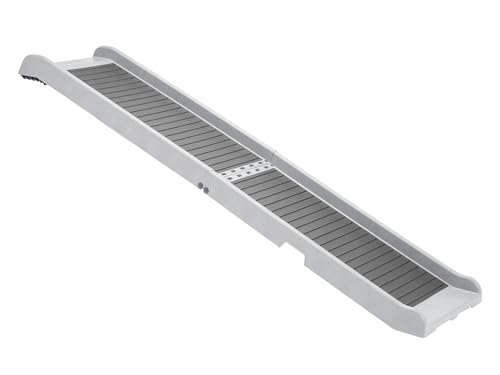



Why the spine cares about the angle, not just the height
Intervertebral disc disease, IVDD, affects breeds with long backs and short legs, most notably dachshunds, corgis, and basset hounds, and puts them at risk of disc injury from sudden twisting, jumping, or awkward landings. A ramp moves a dog's spine through a continuous, gentle incline with no repeated flexion at each step. Stairs or steps require the spine to flex and extend at every single riser, which for a dog already prone to disc problems can be exactly the kind of repetitive stress vets advise against.
What vets generally recommend for IVDD-prone dogs
For dogs already diagnosed with IVDD, or breeds known to be at elevated risk, a ramp is usually the safer default over a stepped product, precisely because it avoids the repeated up-down flexion of stair climbing. That said, "usually" isn't "always," since the right choice depends on the individual dog's diagnosis, recovery stage, and vet's specific guidance. A dog recovering from disc surgery may have entirely different movement restrictions to a dog managing a mild chronic condition, so this is genuinely a case where you follow your vet's advice over a general rule.
Where steps can still make sense
Steps take up less floor space than a ramp long enough to be gentle, and some healthy, non-IVDD-risk dogs manage steps without any issue their whole lives. If your dog isn't a breed prone to IVDD and has no diagnosed spinal issue, steps aren't automatically dangerous, the concern is specific to dogs whose discs are already vulnerable or degenerating.
Ramp angle matters as much as ramp-vs-steps
A poorly designed ramp that's too steep can undo the benefit entirely, since a steep incline still forces significant spinal flexion, just spread differently than stairs. For an IVDD-prone dog, look for the gentlest angle you can fit in the space available, ideally under 20 degrees, rather than assuming any ramp is automatically safer than any set of steps. A short, steep ramp can be worse for a vulnerable spine than a well-designed, shallow set of steps.
The one-line rule
If your dog has a diagnosed back condition, has had disc surgery, or belongs to a breed with known IVDD risk, talk to your vet before choosing between a ramp and steps, and follow their specific movement guidance over general advice found online. This is one of the areas where individual veterinary assessment genuinely changes the right answer, since recovery-stage restrictions and long-term management look very different from each other.
Everyday habits that matter as much as the equipment
Buying the right ramp is only part of managing an IVDD-prone dog's spine day to day. Discouraging jumping on and off furniture generally, not just at the specific spots you've fitted a ramp, reduces the cumulative risk of a disc injury. Twisting is a bigger risk factor than most owners realise too: a dog that turns sharply mid-air chasing a ball, or spins to catch a toy, puts real torsional stress on the spine, so limiting that kind of play in a known at-risk dog is worth discussing with your vet alongside any ramp or step decision. Keeping a dog at a healthy weight also reduces the load on the spine at every point of movement, ramp included, and is one of the few factors owners have full control over. None of this replaces a vet's assessment, but a ramp fitted correctly, combined with these everyday habits, gives an IVDD-prone dog the best chance of avoiding a preventable injury.