


Why Some Harness Designs "Work" and Others Don't
A dog pulling on lead is a mechanics problem before it's a training problem: whatever surface the leash pulls against is the surface the dog leans into. A flat collar sits against the throat. A back-clip harness puts the leash ring between the shoulder blades, directly over the muscles a dog uses to haul weight forward. That's why a plain back-clip harness, on its own, rarely stops pulling. It removes throat discomfort (a genuine welfare upgrade over a collar for a strong puller) but gives the dog a stable platform to lean into, and some dogs pull harder once it stops hurting to do so. Front-clip harnesses and head halters solve the same problem differently, by moving the point of leverage somewhere pulling doesn't pay off. None of the three is "the no-pull harness", they're three different mechanisms, each suited to different dogs.
Back-Clip Harnesses
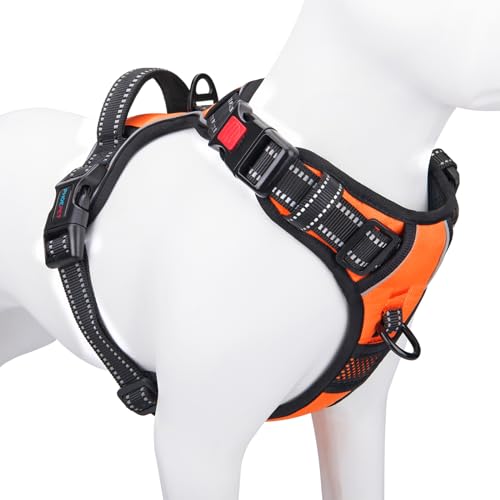
The ring sits over the shoulders, in line with the dog's centre of gravity. Because the pull force lines up with the direction the dog is already moving, there's very little steering leverage, the harness mostly just distributes the load comfortably. This makes back-clip the right choice for dogs who already walk politely, small or toy breeds where a front ring would swing and tangle, and brachycephalic breeds (pugs, bulldogs, French bulldogs) who should avoid any pressure near the airway. It's a comfort-first design, not an anti-pull mechanism.
Front-Clip Harnesses
The ring sits on the chest, ahead of the dog's shoulders. When a front-clipped dog pulls forward, the leash tension pulls the chest sideways instead, the dog's momentum gets redirected off-line rather than reinforced. Practically, this means a hard lunge turns the dog partway around instead of dragging you forward, which interrupts the pulling motion without any pain or choking involved. It's a widely used starting point for pulling dogs of almost any size because it needs no conditioning period and most dogs tolerate it from the first walk.
The trade-offs: the leash can swing across the front legs and tangle during turns, and because the harness does the redirecting rather than the dog learning to check its own pace, some dogs never fully generalise loose-leash walking off a front clip alone, pulling can return the moment the harness comes off. It works best paired with basic loose-leash training rather than used as a permanent substitute for it.
Head Halters
Halter-style designs (a nose loop plus a strap behind the ears, leash clipping under the chin) work on a different principle entirely: where the head goes, the body follows. Because dogs steer with their head and neck far more than most owners expect, a head halter gives the most steering leverage of the three designs, which is why trainers often reach for one with large, strong dogs or dogs that lunge hard at other dogs or wildlife.
The trade-off is that head halters need a proper introduction. Most dogs paw at their face and try to rub it off for the first several wears, this isn't the halter "not working," it's a normal reaction to a new sensation near the muzzle that settles with short, treat-paired sessions before it's used on an actual walk. A head halter is not a muzzle and shouldn't be marketed or used as a way to stop biting, it doesn't restrict the mouth. It also must never be used with a hard jerk or leash-popping correction; because the nose loop concentrates force on a small area, a sharp yank risks neck strain in a way a body harness doesn't. Used gently, with slack in the leash and steady guidance rather than snapping corrections, it's a humane and effective option, the harshness comes from how a tool is handled, not from the design itself.
Dual-Clip and Hybrid Harnesses
Many current harnesses now include both a front chest ring and a back ring on the same piece of equipment, letting you switch attachment points depending on the situation, front clip through a distracting street, back clip on a calm trail. This versatility is genuinely useful and is one reason dual-clip designs dominate general buying guides, but it's worth remembering it's still two of the same three mechanisms described above, just combined into one product.
Matching the Design to the Dog
- Small or toy breeds, or already-trained walkers: a well-padded back-clip harness is usually all that's needed.
- Moderate pullers, most family dogs: a front-clip or dual-clip harness is the standard starting point.
- Strong or determined pullers, reactive dogs, or large breeds where a front clip alone isn't enough leverage: a head halter, introduced gradually and used gently, offers the most control.
- Brachycephalic breeds: avoid any collar-based pressure; a harness (front- or back-clip) is the safer category regardless of pulling level.