


Why Fit Matters More Than Brand
The single biggest factor in whether a harness stops pulling, stays on, and doesn't irritate your dog's skin isn't the brand or the price, it's whether it's sized and adjusted correctly. A premium harness fitted loosely will let a determined dog back out of it; a budget harness fitted precisely will do its job comfortably for years. Most of the complaints that show up in owner reviews, chafing, escaping, the harness "not working", trace back to measuring or adjustment, not the product itself. Getting the fit right takes ten minutes with a soft tape measure and is worth doing properly before the first walk.
Measuring Your Dog
You need two numbers for almost every harness: girth and, for some styles, neck circumference.
- Girth is measured around the widest part of the ribcage, just behind the front legs, wrap a soft (cloth or sewing) tape snugly but not tight, the way the harness's chest strap will actually sit.
- Neck circumference, where needed, is measured around the base of the neck, roughly where a collar would sit, not right up against the jaw.
- Back length, on some styles, runs from the base of the neck to just before the tail, mainly relevant for harnesses with a coat-style back panel.
The Two-Finger Rule
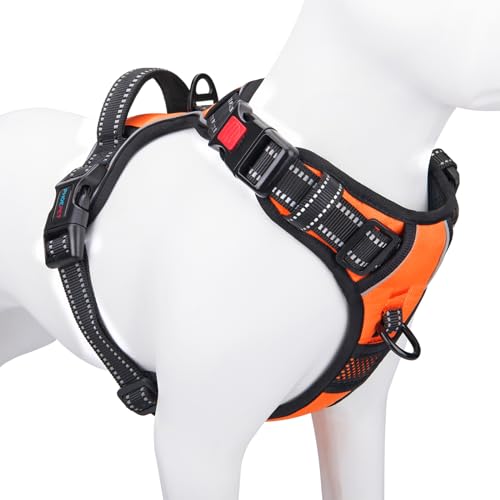
Once the harness is on, check every strap the same way: you should be able to slide two fingers flat underneath it, snugly, without forcing them in and without an inch of slack. Too loose and the dog can wriggle a leg or the whole head through a gap; too tight and it digs in during movement or restricts the shoulder's natural range of motion. Check this at the neck opening, both sides of the chest strap, and the girth strap, dogs aren't perfectly symmetrical, and a harness that's snug on one side can gape on the other after adjustment. Recheck after the first few minutes of walking, since some webbing settles slightly once weight is on it.
Escape-Proofing
A small number of dogs, often narrow-skulled breeds like sighthounds, or simply anxious dogs who panic and pull backward, can back straight out of a harness that isn't secure at the neck. Signs to watch for: a neck opening that a hand can slip through easily, or a dog that has slipped a harness before. Fixes include tightening the neck strap to a true two-finger fit (not looser "for comfort"), choosing a harness with a martingale-style loop that snugs slightly under backward tension without choking, and, for any dog with a known escape history, keeping a well-fitted collar and ID tag attached as a backup point of contact until you trust the fit completely. A step-in style can also be worth trying for dogs that resist anything going over the head.
Fixing Rubbing and Chafing
Chafing almost always shows up in the same two spots: just behind the front legs, where the girth strap crosses, and across the top of the chest where a front ring sits. After a walk, part the fur and check for redness, thinning hair, or a hot spot starting to form, catching it early avoids a real sore developing. Common causes and fixes:
- Strap too tight or riding at an angle, loosen slightly and recheck the two-finger rule; a strap that's crooked concentrates pressure on one edge.
- Thin webbing on a thin-coated or sensitive-skinned dog, look for a padded or wider-webbing style rather than narrow strapping.
- New harness, tender skin, some dogs need a short break-in period; keep early walks shorter while skin adjusts to a new pressure point.
- Weight or coat change since the harness was bought, a harness that fit in winter coat can pinch after a summer shed, and vice versa; recheck fit every few months, and always after any noticeable weight change.
A Quick Pre-Walk Habit
Before clipping the leash on, run two fingers under the neck and girth straps and glance at the chest for any twisting. It takes ten seconds and catches the two most common problems, a slipped adjustment or a strap that's crept out of place, before they turn into an escaped dog or a sore spot. Fit isn't a one-time setup step; it's worth a quick check every time the harness goes back on, especially for growing puppies and dogs whose weight fluctuates.