

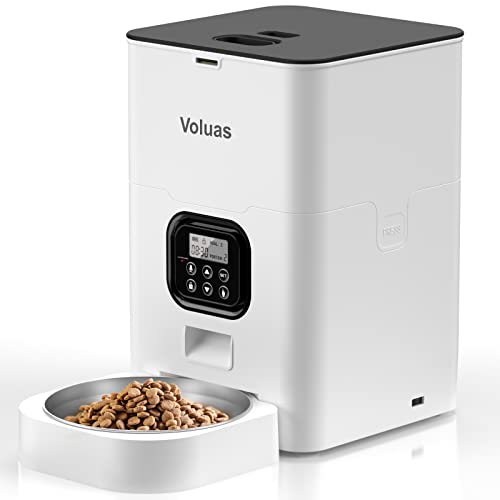

An automatic feeder is a mechanical promise: at a set time, a set amount of food lands in the bowl, whether or not a human is watching. Most of the time that promise holds. The real question is what happens on the days it doesn't, and whether your dog can absorb that failure without harm. There are three failure modes worth understanding, and they are not equally serious.
Failure mode one, mechanical jams
Every motorized feeder works the same basic way, a rotating disc, auger, or paddle carries kibble to a chute and drops a measured amount into the bowl. The weak point is kibble geometry. Large, flat, or oddly shaped pieces can wedge across the dispensing opening instead of falling through cleanly, a problem often called "bridging", and the motor either stalls or spins uselessly above a blocked chute.
A few patterns show up consistently:
- Larger kibble jams more than small kibble. Feeders sized for cats and small dogs are usually tuned to a narrower dispensing gap, which is exactly why several budget units explicitly market themselves for smaller breeds, the mechanism wasn't built around chunky large-breed kibble.
- Humidity makes it worse. Kibble that's absorbed even a little moisture gets tackier and clumps more, which is part of why a sealed hopper or a desiccant slot tends to jam less than a fully open design.
- A near-empty hopper is a common trigger, since low kibble settles at odd angles instead of feeding straight down.
Failure mode two, power loss
A feeder running purely on a wall adapter has no memory of its schedule once power cuts, it either sits dead until power returns or, worse, loses its programmed times entirely.
Battery-only feeders (D-cells or similar, no mains connection) simply don't experience this kind of failure. The trade-off is that batteries themselves run flat, often with only a vague low-battery indicator, trading one failure point for another you have to actively monitor.
Dual-power feeders plug into the wall as primary but automatically fall back to batteries the moment mains power drops, then switch back when it returns, the more resilient design for a genuine outage, since it removes the need to babysit battery life day to day.
The households most exposed here are the ones who travel and leave a feeder unsupervised. A power cut you're home for is a minor inconvenience. The same cut on day two of a trip, with nobody checking, is a dog missing meals with nobody the wiser until you're back.
Failure mode three, portion drift and the obesity risk
This is the quiet failure, and arguably the more consequential one, because it doesn't look like a malfunction. Two different things get lumped under "portion control":
Gravity dispensers aren't timed feeders with a bug, they're a different category that never had portion control to begin with. They refill the bowl by gravity as it empties, with no schedule and no measured amount. For a self-regulating dog that's harmless; for a food-motivated dog it's a standing invitation to overeat, and unrestricted access like this is one of the most common, most preventable routes to canine weight gain. If your dog free-feeds and struggles with weight, the fix isn't a better gravity feeder, it's a timed one.
Timed feeders with a drift problem are subtler. Portion accuracy on scoop-and-drop mechanisms can vary meal to meal and shift further with unusually small, large, or dusty kibble, since the same volume doesn't weigh the same across brands. That "3 cups a day" dial setting is an approximation, not a calibrated measurement. If your dog's weight is being actively managed, it's worth periodically weighing what the feeder actually dispenses over a day rather than trusting the label indefinitely.
When an automatic feeder should not be the only safety net
None of these three failures are catastrophic for a healthy dog on a normal diet with someone checking in daily. The picture changes for specific dogs:
- Dogs on a medical feeding schedule, most notably diabetic dogs whose insulin dosing is timed to meals. A missed or mistimed feeding here is a medical event, not an inconvenience, and a mechanical device with any nonzero failure rate should never be the only safeguard.
- Aggressive or destructive eaters that will paw, chew, or tip a plastic unit until it breaks, built for a calm eater, not this.
- Multi-dog households, where a faster or more dominant dog can push a slower one away from the dispensing bowl.
- Dogs prone to overeating or resource-guarding food, where automation removes the human oversight that would otherwise catch a problem early.
The honest bottom line
Jams are real but largely predictable and testable in advance. Power loss is real but solvable with dual-power or battery-only designs. Portion drift is real but manageable with a timed feeder and the occasional check-weigh. None of that means don't buy one, it means know exactly which of these three things could go wrong for your dog, and make sure something, or someone, is watching for it besides the machine.