
Best Dog Food By Life Stage And Breed Size
Best Dog Food By Life Stage And Breed Size, ranked from aggregated owner ratings and reviews, not first-hand testing. Real pros, cons, and who each pick is best for.


Our Top 3 Picks
Quick Comparison
| Product | Best for | Buy | |
|---|---|---|---|
| Blue Buffalo Life Protection Formula Chicken Puppy Dry Dog Food | Best for Puppies | See Amazon | View |
| Purina Pro Plan Large Breed Dry Puppy Food, Chicken & Rice | Best for Large-Breed Puppies | See Amazon | View |
| Purina ONE Plus Senior Dry Dog Food, Adult 7+ | Best for Senior Dogs | See Amazon | View |
| Hill's Science Diet Adult 7+ Small Bites Dry Dog Food | Best for Senior Small Breeds | See Amazon | View |
| Blue Buffalo Life Protection Formula Chicken Senior 7+ Dry Dog Food | Best Senior Joint-Support | See Amazon | View |
| Nutro Natural Choice Senior Small Breed Dry Dog Food | Best Value Senior Small Breed | See Amazon | View |
A dog's needs change as it grows, and so should its bowl. Puppies need food built for rapid growth, adults need steady maintenance, and seniors often need fewer calories with easier chewing and joint support. Breed size shifts this further: a Chihuahua and a Labrador reach these stages at different ages, burn calories at different rates, and need different kibble sizes. Feeding a big-breed puppy a rich, unrestricted growth food, for instance, can push its bones to grow faster than is healthy. This guide matches six mainstream foods to the life stage and body size each one genuinely fits best.
How we chose
- We didn't feed these in a controlled trial, and we won't pretend otherwise. We compared each food's stated life stage, breed-size targeting, kibble size, and published recipe.
- We used the AAFCO life-stage wording brands put on the bag (growth, maintenance, or all life stages) as the anchor, since that reflects how the food was formulated.
- We factored in what owners commonly report about palatability and kibble size for small versus large mouths, described in general terms only.
- We assigned each product one clear role rather than claiming any single bag suits every dog at every age.
The criteria that separate good from bad
The right food for the right stage. Growth formulas are richer for a reason, and senior formulas usually trim calories. For puppies, Blue Buffalo Life Protection Formula Puppy is our best overall growth pick, while Purina Pro Plan Large Breed Puppy is the one to choose for a big-breed pup, because large-breed growth foods are formulated to support a slower, steadier bone development. Our guide to feeding your dog by life stage explains why those differences matter.
Breed size and kibble size. A small dog needs small pieces it can actually chew. Hill's Science Diet Adult 7+ Small Bites is our pick for senior small breeds, Nutro Natural Choice Senior Small Breed is the value option in that same lane, and Purina ONE Plus Senior 7+ covers senior dogs more broadly. Getting size right is as important as getting the recipe right, which we cover in small vs. large breed food.
Support that suits older joints. Many senior dogs benefit from formulas that ease everyday movement. Blue Buffalo Life Protection Formula Senior 7+ is our joint-support-minded senior pick for that reason, with a recipe aimed at older dogs that are slowing down but still eating well.
Calories matched to activity. Older, less active dogs gain weight easily, and a puppy that has stopped growing but is still fed puppy portions will do the same. Watch your dog's body condition rather than just the scoop, and cut back gradually as activity drops. A senior at a healthy weight moves more comfortably and tends to stay healthier longer.
Kibble your dog can manage. Life stage and size both affect what a mouth can chew. Puppies and small seniors do best with smaller pieces, and a dog that struggles with large kibble may simply eat less of a perfectly good food. If chewing is a problem, adding a little warm water to soften kibble is a simple, cheap fix.
The honest limits
This is general guidance on matching food to life stage and size, not veterinary or nutrition advice for your individual dog. "Senior" and "puppy" on a label are formulation categories, not medical diagnoses, and the age a dog becomes a senior varies a lot by breed and size.
We can't tell you the exact food or portion for a dog we haven't met. Puppies, pregnant or nursing dogs, and dogs with health conditions have specific needs, and a food that suits one senior may not suit another. Age on a label is a rough guide, not a birthday: a small dog may not be "senior" at seven, while a giant breed can be well into old age by then. If your dog is gaining or losing weight, slowing down suddenly, or showing joint pain or appetite changes, talk to your veterinarian rather than switching foods on a guess, because those signs can point to a health issue that food alone won't address. Always follow the label's feeding guide and change foods gradually over about a week.
Full Ranking, Reviewed

Best for Growing puppies who need DHA-supported brain and muscle development
- DHA for brain development
- Real chicken as the first ingredient
- LifeSource Bits antioxidant blend
- 30 lb bag
- Strong owner ratings for a puppy formula, from a large owner base
- DHA inclusion targeted at cognitive development
- Same trusted Blue Buffalo recipe base as the adult line
- Large-breed puppies may need a breed-specific large-breed puppy formula instead for controlled calcium levels
- Chicken-based, unsuitable for poultry-sensitive puppies
Verdict: A well-reviewed general puppy formula, but large-breed puppies should generally move to a large-breed-specific recipe (see our large-breed pick) to control growth rate.

Best for Large-breed puppies who need controlled calcium for healthy joint development
- Calcium calibrated for large-breed skeletal growth
- DHA for brain and vision development
- 34 lb bag
- Chicken & rice formula
- Well-regarded within the large-breed puppy category
- Purpose-built calcium ratio rather than a generic puppy formula
- Widely recommended for breeds prone to rapid growth
- More expensive than a generic all-breed puppy food
- Rice-based, not suited to grain-free feeding plans
Verdict: The safer choice over a generic puppy formula for any dog projected to exceed roughly 50-70 lbs as an adult, ask your vet about growth-rate feeding for your specific breed.

Best for Senior dogs (7+) who need a maintenance formula tuned to a slower metabolism
- Vibrant Maturity formula for 7+ dogs
- Real chicken as the first ingredient
- Antioxidant blend included
- 31.1 lb bag
- A solid, well-regarded track record among senior-dog owners
- Formulated specifically for the 7+ life stage rather than repurposed adult food
- Large bag size suits multi-dog senior households
- Doesn't include the joint-support supplement levels some dedicated senior formulas carry
- Best paired with a vet check for dogs with age-related health conditions
Verdict: A reasonable everyday senior formula, dogs with diagnosed joint or organ conditions should be on a diet their vet has specifically reviewed.

Best for Senior small-breed dogs who need smaller kibble and vet-formulated nutrition
- Small Bites kibble size for smaller mouths
- Chicken meal, barley & rice formula
- Formulated for the 7+ life stage
- 5 lb bag sizing
- One of the best-regarded senior formulas in this list
- Small kibble size suits toy and small-breed seniors
- Widely recommended by veterinary clinics
- Smaller bag sizes cost more per pound than bulk formulas
- Grain-inclusive, not an option for grain-free households
Verdict: A vet-favoured, small-kibble senior formula that's easy to recommend for aging small-breed dogs.
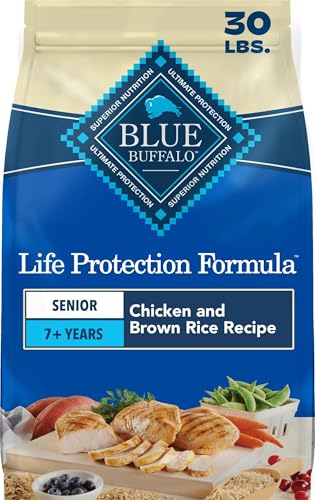
Best for Senior dogs who could benefit from added glucosamine and chondroitin
- Glucosamine & chondroitin for joint health
- LifeSource Bits antioxidant blend
- Real chicken as the first ingredient
- 30 lb bag
- Well-reviewed senior formula
- Built-in joint-support ingredients beyond basic maintenance
- Same trusted recipe line as Blue Buffalo's puppy and adult foods
- Glucosamine/chondroitin levels are a maintenance dose, not a substitute for a vet-prescribed joint supplement
- Chicken-based, not suitable for poultry-allergic dogs
Verdict: A sensible pick for senior dogs starting to show mild stiffness, though dogs with diagnosed joint disease need a vet-directed plan.

Best for Budget-conscious owners of small senior dogs
- Chicken as the first ingredient
- Beet pulp prebiotic for digestion
- Omega-3 & omega-6 fatty acids
- Vitamin E & selenium antioxidants
- Well-rated for a smaller, more affordable bag
- Small-breed kibble sizing
- Includes basic digestive and skin-support ingredients
- Smaller 5 lb bag needs more frequent reordering for daily feeding
- Fewer joint-specific ingredients than dedicated senior-joint formulas
Verdict: A budget-friendly senior small-breed option that covers the nutritional basics well.


Frequently Asked Questions
When should I switch my dog from puppy to adult food?
It depends mostly on size. Small breeds often reach adulthood around 9 to 12 months, while large breeds like those fed Purina Pro Plan Large Breed Puppy may stay on growth food until 18 to 24 months so their bones develop steadily. Because the timing varies, confirm the right point for your dog with your veterinarian rather than switching by a fixed date.
What makes senior dog food different?
Senior formulas such as Purina ONE Plus Senior 7+ or Blue Buffalo Senior 7+ are generally adjusted for older dogs, often with controlled calories and ingredients aimed at supporting aging joints and easier digestion. They are still complete everyday foods, not medical diets. If your senior has a diagnosed condition, ask your vet whether an ordinary senior food is enough.
Do small breeds really need small-breed food?
The biggest practical reason is kibble size. Small dogs chew and swallow small pieces more easily, which is why picks like Hill's Science Diet Small Bites and Nutro Natural Choice Senior Small Breed use smaller kibble. Small breeds also have faster metabolisms, so calorie density matters. Matching portion to weight is what counts most.
Can I feed one food to dogs of different ages?
Foods labeled "all life stages" are formulated to meet the needs of growth, which makes them broadly usable, but a growing puppy and an older senior still have different calorie needs. In a multi-dog home it is usually better to feed each dog a food matched to its stage and size, and to feed them separately so portions stay correct.