Winter Coats & Rainwear for Dogs
Comprehensive technical analysis of material density, anatomical weight distribution, Indentation Load Deflection (ILD) thresholds, and veterinary standards for winter coats & rainwear.

Recommended Products
See the full ranking →

Dog Winter Coats and Rainwear, What Actually Matters
A dog coat is one of those purchases where the marketing photo does most of the selling and very little of the useful thinking. Before you look at colours and quilting, the real questions are simpler: does your dog actually need a coat, does it fit, and is it built for cold, wet, or both? Get those three right and almost any well-reviewed coat will do the job. Get them wrong and the most expensive jacket on the page will sit unused in a drawer.
Not every dog needs one, and dressing a dog that doesn't can cause overheating rather than comfort. The dogs that genuinely benefit are the ones that struggle to hold their own body heat:
- Thin-coated and single-coated breeds, greyhounds, whippets, Italian greyhounds, boxers, pointers, staffies and pit-bull types. They have little insulation of their own and feel cold quickly.
- Small and toy breeds, chihuahuas, min pins, Yorkies and similar. A high surface-area-to-body-mass ratio means they lose heat fast, and they sit closer to cold, wet ground.
- Senior dogs, older joints and slower circulation make cold harder to tolerate, and stiff, achy mornings are worse in the chill.
- Puppies, they don't regulate temperature as well as adults and tire faster in the cold.
- Sick, recovering or very lean dogs, anything without a fat layer or with a compromised system holds heat poorly.
More returns come from bad sizing than bad quality. Dog coats are cut by two measurements, and buying by weight alone is the single most common mistake:
Measure with the dog standing, use a soft tape, and if you land between sizes on the chart, size up. Two dogs of the same weight can be completely different shapes, a stocky staffy and a lean lurcher can weigh the same and need different coats.
These are three different jobs, and most coats do one well:
- Warmth comes from insulation, fleece linings and quilted "puffer" construction. These trap air and body heat but soak up water, so they are for cold, dry days.
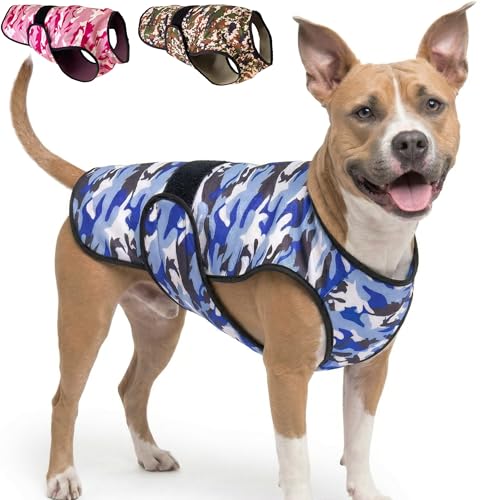
- Waterproof comes from a sealed outer shell that sheds rain. Many coats labelled "waterproof" are really only water-resistant, fine for a shower or snow, not for a sustained downpour. If rain is your real problem, look specifically for a true waterproof shell.
- Both means a waterproof outer over an insulated lining. This is the most versatile option and, for changeable winters, usually the smartest buy. Reversible coats that offer a warm side and a shower side are a budget-friendly version of the same idea.
A coat the dog can't move or toilet in comfortably is a coat that gets left at home. Check three things:
- Leg and shoulder freedom, the dog should be able to walk, run and sit without the coat pulling at the front legs. Puffer bulk is the usual culprit for restricted stride.
- Belly coverage vs toileting, for female dogs especially, the belly panel needs to be short enough at the rear that it doesn't get soiled. Male dogs need clearance too.
- Getting it on and off, buckles are faster and more secure on wriggly dogs than hook-and-loop, which also collects fur and weakens over time. Zips are quick but can catch long coats.
Winter walks happen in the dark at both ends of the day, and drivers see far less than you think. Reflective strips on a coat are a genuine safety feature, not a styling detail, they catch headlights and give a driver crucial extra reaction time. Treat reflectivity as a real selection criterion if you walk near roads. That said, reflective trim works only when light hits it; for the darkest routes, add an active light source, a clip-on LED or a light-up collar, so your dog is visible even when no car is pointing at them.
Buying the right coat also means knowing when it's needed. Watch for shivering, a tucked or hunched posture, reluctance to keep walking, lifting or favouring paws off cold ground, whining, or slowing right down. Cold ears and a cold body are warning signs; shivering that doesn't settle means it's time to head home and warm up. A coat helps a dog that runs cold, but it is not a substitute for cutting a walk short in genuinely dangerous conditions.
Go Deeper
Detailed companion guides for winter coats & rainwear.
Which Dogs Actually Need a Coat? A Breed, Body and Condition Guide
A breed-by-breed, condition-by-condition look at which dogs genuinely need extra warmth outdoors, which ones a coat can actually work against, and how age…
How to Measure Your Dog and Actually Get the Fit Right
A step-by-step measuring method, why brand size charts don't line up with each other, and the fix for each of the five most common coat fit problems once it…