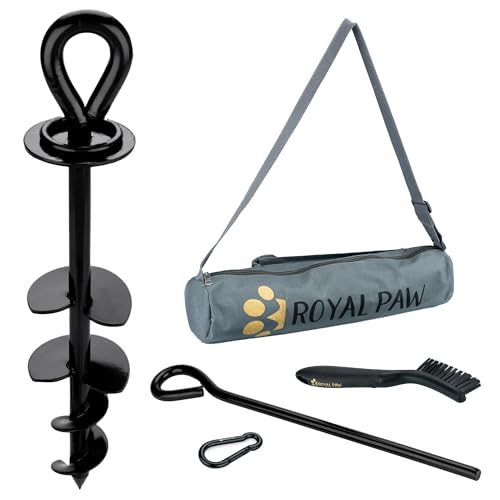


What an overhead trolley run actually is
An overhead trolley run, sometimes called a zipline or aerial run, is a length of cable stretched between two fixed anchor points, usually trees or set posts, with a sliding trolley or pulley riding along it. A shorter leash or tether drops down from the trolley to the dog's harness, and as the dog moves back and forth, the trolley travels with them along the overhead cable instead of the tether staying anchored to one spot on the ground. The core idea: move the swivel point up and out of the dog's way, so the tie-out line isn't dragging through grass, wrapping around a stake, or looping around the dog's own legs every time they change direction.
This is a containment tool, not a fence or walk replacement, that's covered in our companion piece on trolley run safety and humane use. This guide is about the hardware itself: the components, how the run is sized, and why the geometry solves the tangling problem a ground stake creates.
The core components
Aircraft cable. The overhead line itself is typically galvanized or stainless steel aircraft cable, sold by diameter (commonly in the 1/8" to 3/16" range for residential dog runs) and rated by breaking strength in pounds. Cable is used instead of rope or chain because it resists stretching, doesn't fray the way rope does under repeated flexing, and holds its line taut across a long span without sagging as much under the trolley's weight.
Anchor points. Each end of the cable needs a fixed point strong enough to take sustained lateral pulling force, mature trees of sufficient trunk diameter, or purpose-set posts sunk deep enough not to lean or work loose over a season of use. The anchor hardware (eye bolts, cable clamps, turnbuckles) needs to be rated to at least the same working load as the cable itself; a weak link at the anchor defeats a strong cable.
The trolley or pulley. This is the sliding component that rides the cable, either a wheeled trolley with an enclosed track or a simple pulley wheel with a swiveling drop hook. A trolley with a full enclosure around the cable tends to run smoother and is less prone to jumping off the line under a hard lateral pull than an open pulley, though both styles work when properly rated and installed.
The drop line. A shorter secondary leash or tether runs from the trolley down to the dog. Length here matters for two reasons: enough to let the dog move and lie down comfortably, but short enough that it doesn't reach the ground and start dragging or catching on obstacles as the trolley travels.
Sizing the run, height, length, and clearance
Height. The cable is typically set high enough that the trolley and drop line clear a standing, jumping dog without dragging on their back, but low enough that slack doesn't pool at ground level when the dog is standing still. For most dogs this lands around 7 to 10 feet at the anchor points, though the working height depends on the dog's size and how much the cable sags at mid-span.
Length. Run length trades off the space available against how much room the dog needs. A run stretched across a reasonably open yard, no obstacles, drop-offs, fences, or hazards along its path, gives a usable rectangle of movement roughly the drop line's width on either side of the cable's length. Shorter runs are easier to keep taut and predictable; longer runs need a heavier cable and stronger mid-span support to avoid excessive sag.
Weight rating. Every component in the chain, cable, trolley, drop line clips, anchor hardware, should be rated well above the dog's body weight, accounting for the added force of a hard lunge or a sudden stop at a dead run. Manufacturers publish a maximum dog weight for a given run kit; treat that as a ceiling, not a target, and lean toward the more heavily rated option for a strong puller.
Why a trolley reduces tangling compared to a stake
A ground stake keeps the tether's pivot point fixed at one spot on the ground. Every time the dog circles a tree, doubles back around the stake, or investigates something off to one side, the line wraps, around the stake, around furniture, around the dog's own legs, and the usable range shrinks with every wrap until the dog is stuck short or, in a worse case, pulled off balance. An overhead trolley solves this at the geometry level: because the pivot point itself moves along the cable with the dog, there's nothing at ground level for the line to wind around. The dog can move the full length of the run without the tether accumulating wraps the way it does around a fixed stake.
This is the real practical advantage of a trolley system over a ground stake for a dog that paces, circles, or covers ground actively while tied out, less time spent tangled, less risk of a line yanking a dog off its feet mid-stride, and a more predictable range of motion for whoever set the run up.
Setting one up, the practical sequence
A correctly set-up trolley run is fixed outdoor hardware, not a clip-and-forget device, periodic checks of cable tension, anchor security, and trolley wear keep it working the way it was designed to.