
Best Dog Dental Chews
Best Dog Dental Chews, ranked from aggregated owner ratings and reviews, not first-hand testing. Real pros, cons, and who each pick is best for.


Our Top 3 Picks
Quick Comparison
| Product | Best for | Buy | |
|---|---|---|---|
| Greenies Regular Dental Dog Treats, Original Chicken Flavor, 36 Count | Best Overall | See Amazon | View |
| Pedigree Dentastix Large Breed Dental Dog Treats, Variety, 51 Count | Best Value | See Amazon | View |
| ORAVET Dental Chews for Dogs (Small Dogs, 10-24 lb), 30 Count | Best VOHC-Accepted | See Amazon | View |
| Greenies Teenie Original Natural Dental Dog Treats, Chicken, 43 Count | Best for Small Dogs | See Amazon | View |
| Virbac C.E.T. Enzymatic Oral Hygiene Chews for Dogs, Large | Best Grain-Free | See Amazon | View |
| Good 'n' Fun Kabobs Long-Lasting Dog Treat, Real Protein, 24 oz | Best Long-Lasting | See Amazon | View |
How to Choose a Dog Dental Chew
Dental chews are the easiest home habit for slowing plaque and tartar, but the shelf is full of unverified claims. Here is how to choose one that actually earns its place.
Start with the VOHC seal. The Veterinary Oral Health Council independently reviews the evidence behind a chew's plaque or tartar claim and only accepts products that meet its standard. Most chews have never been tested. Prefer a VOHC-accepted chew; acceptance for plaque control is stronger than for tartar alone, because plaque is the soft film you can still intercept. It is the closest thing to proof in a category built on marketing.
Size by your dog's weight, and size up when in doubt. Every reputable chew lists a weight band. A chew that is too small can be swallowed whole or lodge in the throat; one that is too hard for the dog's size can fracture a tooth. If your dog sits between two bands, choose the larger. This is a safety decision, not a preference.
Match texture to your dog's chewing style. Formulated dental chews are deliberately softer so they flex, scrub and break down if swallowed. Rawhide and beefhide chews last longer and scrub more, but they carry the highest choking and blockage risk because dogs tear off chunks. A good hardness test: if you cannot dent it with a thumbnail, it is hard enough to crack a tooth. Avoid bones, antlers and very hard nylon.
Supervise, and remove the end piece. Always watch your dog chew, and take the chew away once it is worn down to a swallowable size, when the choking risk is highest. Fast gulpers are the biggest risk; for them, hold the chew, size up, or lean on brushing instead.
Count the calories. Dental chews are food and many are calorie-dense. Given daily they add up, so fold the chew into the daily calorie budget and trim the main meal a little, especially for small dogs and any dog managing its weight. Obesity is its own health problem.
Remember what a chew is for. A chew reduces buildup mainly on the tooth surfaces it touches, above the gumline. It does not clean the gumline reliably, does not remove hardened tartar, and does not cure dental disease. Daily brushing with dog toothpaste is the gold standard, and professional veterinary cleanings deal with what is already there. A good chew is the easy daily layer on top of brushing and vet care, not a substitute for either.
Bottom line: pick a VOHC-accepted chew in the correct size, match the texture to how your dog chews, supervise every session, and use it alongside brushing and regular vet check-ups. That combination, not any single treat, is what keeps a dog's mouth healthy.
Full Ranking, Reviewed

Best for Medium dogs (25-50 lb) whose owners want a once-daily chew with a genuine VOHC seal behind it
- Accepted by the Veterinary Oral Health Council (VOHC) for helping control tartar
- Chewy, ridged texture that flexes and scrapes along the tooth as the dog gnaws
- Made with soluble ingredients designed to break down in the digestive tract
- Sized by weight band (Regular is for 25-50 lb dogs) so the chew matches the dog's mouth
- One of the very few chews carrying an actual VOHC acceptance for tartar control
- Enormous, consistent owner feedback (tens of thousands of reviews) for reduced visible buildup
- Weight-banded sizing takes the guesswork out of choosing the right chew
- Contains wheat, so it is not suitable for grain-sensitive dogs
- Gulpers can swallow large pieces; the chew must be given whole and supervised, not left with the dog
Verdict: If you want the safest bet in this category, this is it: a mainstream chew with a real VOHC acceptance, sensible weight sizing and a mountain of long-term owner feedback. It reduces tartar between brushings rather than replacing the toothbrush, and you still need to size it correctly and watch a fast eater. For most medium dogs it is the default choice.

Best for Large-breed owners who want a daily chew at the lowest cost per treat
- X-shaped stick with a ridged surface aimed at reaching between teeth
- Marketed as triple-action for tartar, freshening and gum contact
- Sold in high counts (51) that bring the per-chew price down sharply
- Sized for large breeds so the stick suits bigger jaws
- Among the cheapest per-chew options for daily use across a big dog
- Widely stocked and easy to reorder, which helps you actually keep a daily habit
- Softer stick that most dogs finish quickly and readily eat
- Contains cereal/wheat-based ingredients and is lower in real meat than premium chews
- The mechanical scrubbing is light and short-lived, so it does less than a firmer daily chew
Verdict: The honest appeal here is cost and compliance: a daily dental chew is only useful if you give it every day, and at this price you can. Do not expect it to match a firmer VOHC chew for scrubbing power, and read the ingredient panel if your dog avoids wheat. As a cheap way to add daily mechanical cleaning on top of brushing, it earns the value pick.

Best for Owners who care most about the plaque-barrier science and want the VOHC seal front and centre
- VOHC-accepted for helping control both plaque and tartar
- Coated with delmopinol, an ingredient intended to interfere with the bacterial film that forms plaque
- Combines a scrubbing chew texture with the chemical barrier coating
- Weight-banded (this pouch is for 10-24 lb dogs) for correct sizing
- Targets the plaque biofilm chemically as well as mechanically, which few chews do
- Carries VOHC acceptance for plaque and tartar, not just tartar
- Strong owner reports of fresher breath within a couple of weeks
- Costs noticeably more per chew than mainstream sticks
- Some dogs dislike the texture or taste and refuse it, so it is not universally accepted
Verdict: This is the pick for owners who want the strongest hygiene claim on the shelf: a VOHC acceptance covering plaque as well as tartar, plus a delmopinol coating aimed at the bacterial film itself. It is dearer and not every dog takes to it, so buy the smallest pack first to test acceptance. It still supplements brushing rather than replacing it.

Best for Toy and small breeds (5-15 lb) who need a chew scaled to a tiny mouth
- VOHC-accepted for tartar control, in a size built for 5-15 lb dogs
- Slim, flexible texture that a small jaw can actually work on
- High 43-count pack for daily use in a little dog
- Same soluble, digestible formula as the larger Greenies sizes
- Correctly sized for small mouths, which larger dental chews are not
- VOHC acceptance and the same track record as the full Greenies range
- The most popular chew in the category, overwhelmingly positive
- Contains wheat, so unsuitable for grain-sensitive small dogs
- Small dogs can still gulp; the chew must be sized up if your dog is at the top of the weight band and bolts food
Verdict: Small dogs suffer the worst dental disease yet are hardest to fit, and this solves the sizing problem: a properly scaled VOHC chew for 5-15 lb dogs with the whole Greenies pedigree behind it. Match the size band honestly and supervise, because a little dog swallowing a too-big piece is the real risk. For toy breeds it is the clear pick.

Best for Grain-sensitive dogs and owners who want an enzyme-assisted chew from a veterinary brand
- Dual-enzyme coating (a glucose-oxidase / lactoperoxidase system) intended to support the mouth's natural defences
- Single layer of beefhide that provides an abrasive scrubbing action as the dog chews
- Beefhide base is grain-free, unlike most cereal-based dental sticks
- From Virbac, a veterinary oral-care brand, and sized for large dogs
- Adds an enzyme system on top of mechanical scrubbing, a different approach to plain sticks
- Grain-free base suits dogs that react to wheat or cereal chews
- Backed by a veterinary-focused brand with a long oral-care history
- Beefhide is a rawhide-type chew, so aggressive chewers can tear off and swallow chunks that risk choking or blockage
- Rated a little lower by owners than the top chews, and must be given whole under supervision
Verdict: For grain-sensitive dogs this is the sensible pick: a grain-free beefhide base plus a dual-enzyme coating from a veterinary brand. The trade-off is the rawhide caveat, so it is only for supervised chewing, is taken away once it softens to a swallowable size, and is a poor choice for a determined gulper. Chosen carefully it is a solid enzyme-assisted option.
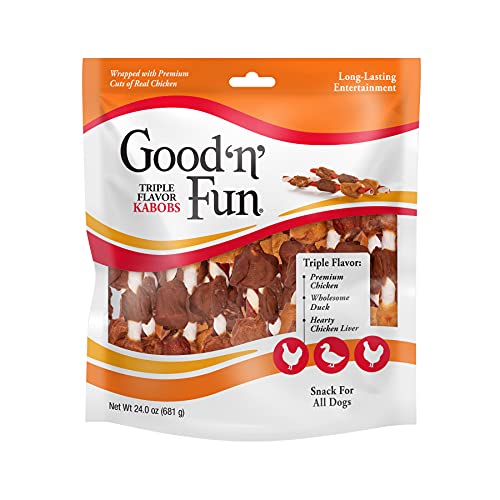
Best for Heavy chewers who need a longer-lasting chew for mechanical cleaning between dental treats
- Rawhide-based kabob made with real chicken, pork and beef protein layers
- Firm, long-lasting construction that keeps a determined chewer occupied
- Extended chewing provides mechanical scraping against plaque and tartar
- Sold in a 24 oz bag for repeat use
- Lasts far longer than a soft daily stick, giving more minutes of scrubbing per chew
- High palatability from the real-protein wrap keeps chewers engaged
- A useful mechanical supplement for dogs that destroy softer chews in seconds
- This is a rawhide chew, not a VOHC-tested dental product, so cleaning is purely mechanical and not verified
- Rawhide carries real choking and intestinal-blockage risk; it must be supervised and removed once chewed down to a gulpable nub
Verdict: Treat this as a chew that happens to help clean teeth, not a formulated dental product. Its value is the long chew time, which gives a strong chewer more mechanical scrubbing than a soft stick manages. But it is rawhide, so the safety rules are strict: supervise, size up, and bin the small end piece. Use it to complement, never replace, a real dental chew and brushing.

Frequently Asked Questions
Do dental chews really work, or is it just marketing?
They genuinely help, but within limits. The chewing action scrapes soft plaque off the tooth surfaces the chew touches, before it hardens into tartar, and some chews add ingredients that interfere with plaque bacteria. The best-supported evidence sits behind chews accepted by the Veterinary Oral Health Council (VOHC), so look for that seal. What a chew cannot do is clean along the gumline where disease starts, remove tartar that has already hardened, or cure dental disease. It reduces buildup between brushings, and works best as one part of a routine rather than on its own.
Can dental chews replace brushing my dog's teeth or a vet cleaning?
No. Daily brushing with a dog-specific toothpaste is the gold standard because it is the only home method that reliably reaches the gumline, which is exactly where gum disease begins. Professional veterinary cleanings under anaesthetic are the only way to remove tartar that has already mineralised and to treat disease below the gumline. A dental chew is a helpful daily supplement that reduces plaque on the tooth surfaces it contacts, but it does not replace either brushing or vet care.
Are dental chews safe? What about choking?
They are safe when used properly, but there are real risks to manage. Choking and intestinal blockage happen when a dog swallows a piece that is too large, which is most likely with a too-small chew, with rawhide or beefhide chews, and with dogs that gulp rather than chew. Always give the chew whole, supervise the whole session, and take it away once it is worn down to a swallowable nub. Very hard chews such as bones and antlers can also fracture teeth, so choose a chew you can dent with a thumbnail. Match the chew to your dog's weight band and size up if unsure.
How many dental chews can my dog have, and will they cause weight gain?
Most dental chews are designed for one per day, but the bigger issue is calories. They are food and many are calorie-dense, so a daily chew can add a meaningful amount of energy, especially for a small dog. To avoid weight gain, count the chew toward your dog's daily calorie total and reduce the main meal a little to compensate. Check the calorie figure on the pack, and be extra careful with small breeds or any dog on a weight-management plan. Follow the manufacturer's daily guidance and do not free-feed chews.