


The Real Question Isn't "Which Carrier", It's "Which Category"
Before comparing individual carrier models, you have to answer a more basic question: is your dog even eligible to travel in the cabin, and if so, does a soft or hard carrier suit them better? Getting this decision right first means you're only shopping within the category that actually applies to your dog, rather than falling for a carrier that's well-reviewed but wrong for your situation.
In-Cabin, The Category Almost Every Small Dog Should Aim For
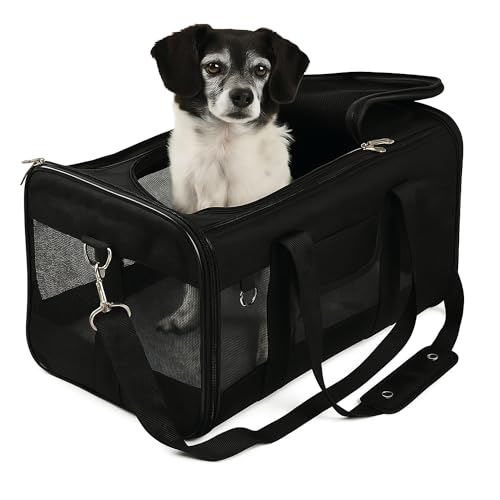
If your dog is small enough, in-cabin travel, riding in a carrier stowed under the seat in front of you, is almost always the better choice on welfare grounds. It's climate-controlled, you can see and hear your dog the whole flight, and there's no separation stress. Airlines set their own maximum combined weight of pet-plus-carrier for the cabin, and it's usually lower than people expect, often somewhere in the 15-20 lb range though this varies by airline, check the exact figure before you buy anything. Within in-cabin carriers, soft-sided bags dominate for a simple reason: a flexible top can compress a little to fit a shallow or irregular under-seat space that a rigid box can't. Look for mesh panels on at least two or three sides for airflow, a secure locking zipper, and a base firm enough that your dog doesn't sag into a hammock shape mid-flight.
Hard-sided in-cabin carriers exist too, and some owners prefer them for the extra structure and impact protection. The trade-off is that a rigid shell won't flex into a snug space, if it's even slightly larger than the seat allows, it simply won't fit, whereas a soft carrier has more room to compromise. If you go hard-sided for the cabin, measure obsessively against your airline's stated dimensions rather than trusting "airline approved" marketing on the box.
Sizing By Dog, Not Just By Carrier Label
Manufacturers size carriers by weight bracket, but the number that actually matters is whether your dog can stand up, turn around and lie down naturally inside, a requirement most airlines enforce and gate staff can act on. Measure your dog's length (base of neck to base of tail) and height (floor to shoulder, or to the top of the head if they hold it up) and compare against the carrier's internal dimensions, not just the weight rating on the label. A dog who is technically under the weight limit but too long or tall for the carrier's interior is still a poor fit. Small and toy breeds (generally under roughly 15-20 lb) are the group most likely to have real in-cabin options across multiple airlines; medium and large dogs increasingly run into cabin ineligibility regardless of carrier choice, simply because they can't physically fit under a seat.
When Cargo Becomes the Only Option
For dogs too large for the cabin, some airlines offer travel in the cargo hold in an approved hard-sided crate, typically built to IATA Live Animal Regulations standards, rigid walls, secure but not padlocked doors, adequate ventilation on multiple sides, and room for the dog to stand, turn and lie down. If cargo is genuinely your only route, prioritise a well-ventilated, correctly sized IATA-compliant crate, acclimate your dog to it in the same unhurried way you would an in-cabin carrier, and avoid connecting flights and layovers where possible since transfers between planes are where conditions are hardest to control.
Why We'd Steer You Away From Cargo Wherever Possible
We're not going to sugarcoat this: cargo travel carries meaningfully more risk than the cabin. Your dog is out of sight and out of your control for the entire journey, conditions in the hold can vary more than in a climate-controlled cabin, and many airlines restrict or seasonally suspend pet cargo for exactly this reason. Flat-faced (brachycephalic) breeds, bulldogs, pugs, boxers and similar, face additional breathing risk and a number of airlines refuse to carry them in cargo at all, sometimes even in the cabin depending on the carrier. If your dog is on the larger side, it's worth asking honestly whether the trip needs to happen by plane, or whether a pet-friendly ground transport service, a longer road trip, or leaving your dog with a trusted sitter is the kinder option. There's no shame in choosing not to fly a dog who isn't a good fit for it.
A Practical Way to Decide
Start by weighing and measuring your dog, then check that figure against your specific airline's in-cabin limit, not a generic number from the internet. If your dog clears it, lean soft-sided, well-ventilated, and correctly sized for comfortable standing and turning room. If your dog doesn't clear it, look hard at whether cargo is truly necessary before booking it, and if it is, invest in a properly sized IATA-standard crate and give your dog real acclimation time beforehand. Airline pet policies, weight caps and breed restrictions all vary and change, so the final check, every time, is a direct read of your airline's current published pet policy, not a carrier's marketing claim.