



Airline-Approved Dog Carriers, What That Label Actually Means
Here is the single most important thing to understand before you spend a cent: "airline approved" is a marketing phrase, not a guarantee. There is no central authority that certifies a carrier as approved for every airline. Each airline sets its own maximum under-seat dimensions and its own weight rules for pets in the cabin, and those rules differ from one carrier to the next and change over time. A bag stamped "airline approved" simply means the maker believes it fits the typical under-seat space on many aircraft. It does not promise it fits the exact plane you are flying on.
So the real workflow is: pick a well-made carrier your dog fits in comfortably, then confirm its exact outer dimensions against your specific airline's published pet policy before you book and again before you fly. Do that and everything else on this page becomes much easier.
Start with under-seat sizing, not the carrier
The space under an airline seat is smaller and more irregular than people expect, and it varies by aircraft type and even by seat within the same plane (a seat with a box or entertainment unit under it loses room). Airlines publish a maximum length x width x height for in-cabin pet carriers. Write those numbers down and compare them to the carrier's outer dimensions, not the internal ones.
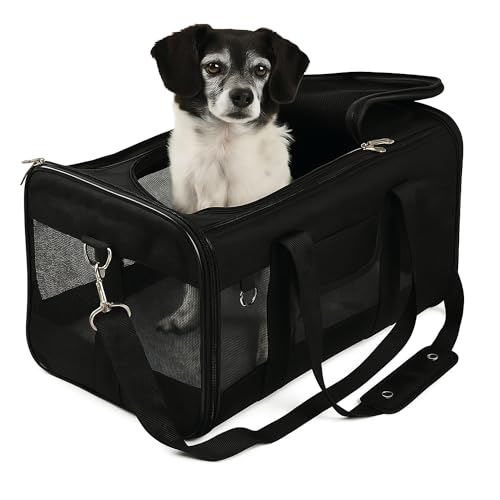
Soft-sided carriers have a genuine advantage here: a flexible top can compress a little to slip into a shallower space, which is why several of our picks are soft bags. But do not rely on squashing a carrier that is far too big, an over-stuffed bag can be refused at the gate.
Your dog also has to fit the carrier
Sizing works in two directions. The carrier must fit under the seat, and your dog must be able to stand up, turn around and lie down naturally inside it. Most airlines require this as a welfare condition, and gate staff can refuse a pet that is visibly cramped. Measure your dog: length from the base of the neck to the base of the tail, and height from the floor to the top of the shoulders (or the head if they hold it high). Then choose the smallest carrier that meets the airline limit while still giving your dog that standing and turning room. If your dog can't get both, in-cabin travel may not be an option for them and you'll need to look at other arrangements.
Soft-sided vs hard-sided
For in-cabin travel, soft-sided carriers dominate for a reason: they flex to fit under-seat spaces, they are lighter, and they are more comfortable against your leg when carried. The trade-off is less impact protection and a floppier structure if your dog is a mover.
Hard-sided carriers give more protection and hold their shape, but rigid walls do not compress, so a hard carrier that is even slightly oversized simply will not go under the seat. Hard carriers come into their own for cargo/hold travel, where sturdiness and secure latches matter, but see the welfare note below before you consider cargo at all.
Ventilation matters more than it looks
Airports and cabins get warm, and a stressed dog pants and heats up quickly. Look for mesh on at least two or three sides so air moves through rather than pooling. Mesh also lets your dog see out, which many dogs find calming, and lets you check on them without opening the zip. A carrier that is well-ventilated on paper but only has one small mesh window is a poor choice for a nervous or brachycephalic (flat-faced) dog.
In-cabin vs cargo, a welfare note
Whenever your dog is small enough to fly in the cabin under the seat in front of you, that is almost always the better and safer choice. The cabin is climate-controlled, you can monitor your dog the whole time, and the stress of separation is removed.
The cargo hold is a different proposition. It can be noisy, temperature swings are possible, and your dog is out of your sight for the entire journey. Some airlines restrict or seasonally suspend cargo pet travel, and flat-faced breeds face extra risk because of their breathing. Where you have any choice, avoid putting your dog in cargo, favour a cabin-eligible carrier, and if your dog is too large for the cabin, seriously weigh whether the trip is worth the risk or whether ground transport is kinder.
Weight limits
Airlines cap the combined weight of pet plus carrier for in-cabin travel, and the cap is often lower than owners assume. Some carriers use a strict number; others simply say the animal must fit comfortably. Because the limit includes the carrier itself, a heavier carrier eats into your allowance, another reason lightweight soft bags are popular. Check your airline's stated weight limit and weigh your dog in the carrier if you are close to the line.
IATA basics
The International Air Transport Association (IATA) publishes Live Animals Regulations that many airlines base their container rules on. The core IATA principles are the ones we keep coming back to: the animal must be able to stand, turn and lie down; the container must be secure, leak-proof and well-ventilated; and the animal must not be able to escape. IATA container standards are strictest for cargo/hold shipment. For in-cabin travel, your airline's own soft-carrier policy is what you follow, but the IATA welfare principles are a good sanity check for any carrier you consider.
Acclimating your dog before the flight
A carrier your dog already trusts is worth more than any feature list. Buy it well ahead of the trip and leave it open at home with a familiar blanket and treats inside so it becomes a normal, safe place rather than a trap that only appears on stressful days. Feed the odd meal in it. Do short carries, then short car trips, building up to the length of your travel day. A dog that is calm in the carrier settles faster at the airport, pants less, and is far less likely to be refused at the gate for distress. Never sedate a dog for flying without explicit veterinary advice, sedation can affect breathing and temperature regulation at altitude.
The bottom line
Choose a well-ventilated carrier your dog can stand and turn around in, prefer soft-sided for the cabin, and treat the "airline approved" sticker as a starting point rather than a promise. The one non-negotiable step is confirming the exact dimensions and weight rules with your specific airline before every trip.