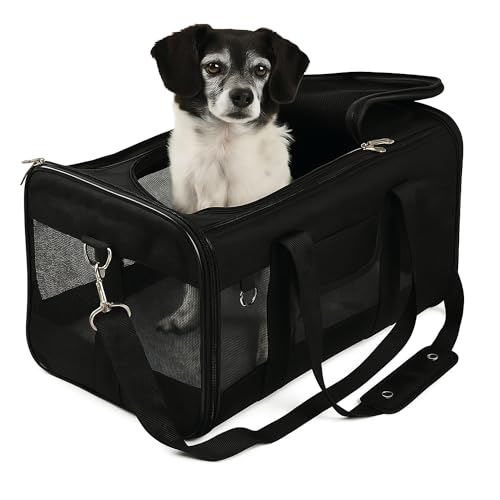

What a hiking backpack carrier is actually for
A dog backpack carrier lets a hiker carry a small dog on their body, usually on the chest, the back, or in a hybrid front-pack style, instead of the dog walking the whole route on its own legs. It's a genuinely useful piece of gear for specific situations: a senior dog whose joints can't handle miles of uneven trail, a small dog whose stride can't keep pace on a long climb, a puppy that hasn't built endurance yet, or any dog that tires, gets injured, or overheats partway through a hike with no easy way back to the car. What it isn't is a default way to bring a dog along on every hike regardless of the dog's fitness or the terrain. A healthy dog that's capable of walking benefits from walking, the exercise, the sniffing, the mental engagement of a trail are a large part of why hiking with a dog is worthwhile in the first place.
Weight limits are a structural fact, not a suggestion
Every backpack carrier on the market has a manufacturer weight rating, and it exists for two reasons: the carrier's seams, straps, and frame are only built to hold so much before something gives, and the human wearing it has a limit for how much weight they can carry stably on uneven ground for hours. Most carriers built for hiking are rated for dogs in the roughly 10-20 lb range, with a handful of sturdier framed packs rated higher. Going over the rated limit isn't just risky for the carrier's stitching, it changes your center of gravity on a trail, which matters a lot more on a rocky descent than it does walking a flat sidewalk. If your dog is close to or over the top of a carrier's rated range, that's a sign the carrier is the wrong size for the dog, not a limit to push against.
Front carry vs. back carry
Front-carried packs, worn like a baby carrier, dog facing out or in against the chest, keep the dog close enough that you can see its face, feel its breathing, and notice signs of distress immediately. That visibility is a real safety advantage, especially for puppies, anxious dogs, or dogs prone to overheating, and it's why many hikers prefer front carry for smaller or younger dogs even though it puts more load on the chest and shoulders over distance.
Back-carried packs distribute weight more like a hiking backpack, which is more comfortable over long distances and heavier loads, but you lose the ability to glance down and check on the dog without stopping and turning the pack around. Back carry works best for dogs who are already calm and well-acclimated to the carrier, on hikes where you're not expecting the dog to need frequent monitoring.
Ventilation and heat, the risk that's easy to underestimate
A dog zipped into a backpack, front or back, loses one of its main tools for regulating body temperature: moving air across its body as it walks. Panting still works, but a dog sitting still inside an enclosed pack, pressed against a hiker's body heat, in direct sun, heats up faster than a dog walking freely in the same conditions. This is the single most common way hiking backpack carriers go wrong, and it's rarely because the gear failed, it's because a dog was left zipped in too long in warm weather.
Look for mesh panels on multiple sides, not just a single vent window, and avoid carriers with dark, non-breathable interior fabric that absorbs heat in direct sun. On the trail, check on a carried dog regularly: open panting, drooling, or a dog that seems unusually still or unresponsive are signs to get the dog out, into shade, and offer water immediately.
Deciding when a dog should walk vs. ride
The healthiest pattern for most dogs who use a carrier is mixed: walking the sections of trail they can handle, and riding for the parts that are too long, too steep, too hot, or too risky underfoot, loose scree, stream crossings, sections with heavy off-leash dog traffic. A carrier used this way extends how far and how often a small or aging dog can join hikes at all, without asking their body to do more than it safely can.
A carrier used as a substitute for any walking, a dog carried the entire route on every hike regardless of ability, misses the exercise and enrichment value of the hike for the dog, and it's worth an honest look at whether shorter, flatter hikes with more walking might suit that dog better than longer hikes spent mostly zipped into a pack.
Why backpack carriers aren't built for large dogs
This isn't a marketing gap, it's physics. Carrying a 40 lb dog on a hiking trail for any real distance is a serious load for even a fit hiker, and no carrier changes the math of that weight shifting on your body as you navigate roots, rocks, and elevation change. Backpack carriers are a small-dog and toy-breed tool by design. For larger dogs that genuinely can't walk a route, injury, post-surgery, advanced age, the safer options are turning back, calling for assistance, or not attempting that trail with that dog that day.
Before hike day, acclimating your dog to the carrier
A dog that's never been in a backpack carrier before shouldn't have its first experience be three miles into a trail. Let the dog explore the carrier at home, reward calm behavior getting in and out, and take a few short, low-stakes walks around the block or a flat local park before attempting a real hike. Check that any internal safety clip is attached to the dog's harness (never a collar) so a startled dog can't leap out mid-stride, and confirm zippers are fully secured before setting out.