Who a dog stroller is actually built for
Dog strollers get an unfair reputation as an indulgence, but for a specific set of dogs they solve a real problem: how do you give a dog fresh air, a change of scenery, and time outside when walking normally isn't safe or possible for them right now? Senior dogs with arthritis or reduced mobility, dogs recovering from surgery or injury where vet-restricted activity rules out a normal walk, dogs with conditions like IVDD or advanced heart disease where exertion carries real risk, and very small dogs who physically can't keep pace with a family's walking speed or distance are all situations where a stroller extends a dog's quality of life rather than replacing exercise it's otherwise capable of. Multi-dog households also use strollers practically, walking one mobile dog on leash while a senior or recovering housemate rides along, so nobody gets left behind on family outings.
What a stroller isn't is a default substitute for walking a healthy dog that's simply not in the mood. If a dog is physically capable of walking, walking remains the better choice for its joints, muscle tone, and mental stimulation, a stroller is a tool for the dogs and situations where walking isn't the available option, not a convenience upgrade for dogs who could walk just fine.
Check weight capacity against your dog's actual weight, with margin
Every stroller has a maximum rated weight capacity, and it's worth choosing one with headroom above your dog's current weight rather than cutting it close, dogs gain weight, multi-dog strollers need to account for both dogs' combined weight, and a frame pushed right up against its rated limit wears out faster and handles less predictably, especially on anything other than flat pavement. If you're stroller-shopping for a dog recovering from surgery who's expected to regain muscle and weight, size up rather than for their current post-surgery weight.
Terrain and wheels matter more than people expect
A stroller built with small plastic wheels for smooth sidewalks will struggle and jostle a fragile or recovering dog on gravel, grass, or park trails, which matters a great deal if the whole point of the stroller is to give a post-surgery or arthritic dog a gentle outing, not a bumpy one. Look at the wheel size and suspension relative to where you'll actually be walking: larger air-filled or foam tires with some suspension travel handle uneven ground far more smoothly than small hard wheels, which is worth prioritizing over cosmetic features if your routes include anything beyond flat, paved sidewalk.
The safety tether inside is not optional
Every dog stroller should have an internal safety clip or tether that attaches to the dog's harness inside the compartment, a dog startled by a passing dog, a loud noise, or simple curiosity can attempt to jump or climb out of an open-top stroller, and a fall from stroller height onto pavement is a genuine injury risk, especially for the older or recovering dogs strollers are most often used for. Treat this the same way you'd treat a car harness: it should be attached every single time the dog is in the stroller, not just on busy or unpredictable outings.
Getting a nervous dog comfortable with a stroller
Many dogs find their first stroller ride disorienting, it moves under them without their own legs doing the work, it's a different height and vantage point than they're used to, and the sides and canopy can feel confining to a dog that's never been enclosed like that before. Introduce the stroller stationary first, letting the dog sniff it and get in and out with treats and no movement involved. Once the dog is relaxed getting in, try a few minutes of very slow, short movement in a quiet, familiar space like a driveway or hallway before attempting a real outing. Rushing this step is the most common reason a dog ends up anxious about a stroller that could otherwise genuinely improve their daily life.
Comfort and ventilation once they're acclimated
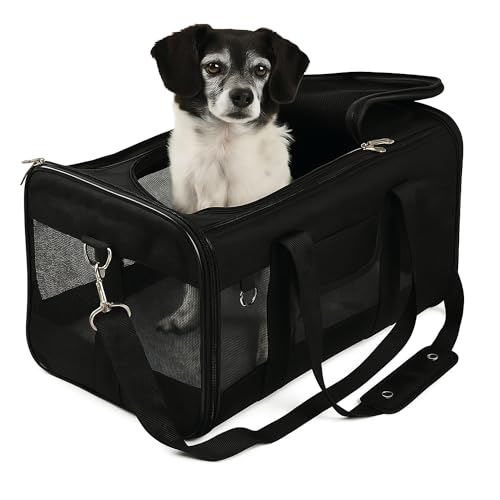
The compartment should give the dog enough room to sit, stand, and turn around without being cramped, a stroller sized for a dog's exact current dimensions with no extra room becomes uncomfortable fast, especially on longer outings. Mesh side panels rather than solid enclosed walls matter for two reasons: airflow, so the compartment doesn't trap heat the way an enclosed carrier can on a warm day, and visibility, since a dog that can see out tends to settle faster than one riding in a fully boxed-in space. A canopy for shade and light weather protection is genuinely useful, but check that it doesn't come at the cost of airflow on hot days, the same heat-buildup risk that applies to backpack carriers applies here.
Using it well, not as a replacement for everything
The strollers that work best long-term are the ones used to extend what a dog can still do, a senior dog getting to the dog park to sniff around and greet friends even though the walk there is now too far on foot, or a recovering dog getting fresh air and family time during a restricted-activity period their vet has prescribed. Used that way, alongside whatever activity level is genuinely appropriate for that dog right now, a stroller is a meaningful quality-of-life tool rather than a shortcut around exercise a healthy dog still needs.