
Best Dog Crates
Best Dog Crates, ranked from aggregated owner ratings and reviews, not first-hand testing. Real pros, cons, and who each pick is best for.


Our Top 3 Picks
Quick Comparison
| Product | Best for | Buy | |
|---|---|---|---|
| MidWest iCrate (Double Door) | Best Overall | See Amazon | View |
| Amazon Basics Wire Crate | Best Value | See Amazon | View |
| BestPet Metal Crate (48-inch) | Best Heavy-Duty | See Amazon | View |
| New World by MidWest (42-inch) | Best for Large Breeds | See Amazon | View |
| Petmate Vari Kennel | Best for Travel | See Amazon | View |
| LifeStages by MidWest (36-inch) | Best for Puppies | See Amazon | View |
How We Chose
We did not run our own containment tests on these crates. Instead, every recommendation here is built from aggregated verified owner reviews and manufacturer specifications, cross-checked against what actually matters in daily crate use. We deliberately favoured crates with large, long-standing review bases, because a crate's real weaknesses (a latch that loosens, a tray that cracks, wire that bends) only show up after months of use, and only a big review pool reveals them honestly. Here is what we weighed.
Sizing and fit
A crate lives or dies on size. We prioritised ranges that let owners match the crate to a measured dog rather than a breed label, and we gave extra credit to crates that ship with a divider panel, because that is what lets a single crate serve a puppy through to adulthood without a second purchase.
Build quality and durability
We looked at wire gauge, latch design and tray construction. Standard folding crates are fine for calm dogs, but we separated out a heavier-gauge, slide-bolt option for large or mildly determined dogs, and we were explicit that none of these folding wire crates is a true escape-proof kennel for a dog with genuine separation-anxiety escape behaviour. Honesty here matters more than a bigger claim.
Doors and everyday practicality
Double-door crates score higher for placement flexibility, since they can sit in a corner or against furniture. We also valued a leak-proof, removable tray, tool-free folding, and whether the crate folds flat for storage or travel. Small details decide whether a crate gets used or resented: rounded corners that will not snag, rubber feet that protect flooring, and a tray that actually slides out cleanly instead of catching every time. We weighted these ordinary, daily-use factors heavily, because they are exactly the things a spec sheet hides and long-term owner reviews expose.
Value, not just price
We did not simply rank by cost. A cheap crate that loosens or bends within months is more expensive than a mid-priced crate that lasts years, so we judged each pick on what it delivers for its price band. The value winner here earns the title by matching pricier crates' core features (double doors, an included divider, a removable tray) at a genuinely lower cost, not by cutting the features that matter.
Purpose fit
Not every dog needs the same crate. We chose distinct winners for distinct jobs: an all-round best pick, a value pick, a heavy-duty pick, a large-breed pick, a travel pick, and a puppy pick with a divider. That way the right crate is matched to the right household, rather than pushing one crate at everyone.
Honesty and welfare
Every pick carries real cons and a clear note on who should skip it, because no crate is right for every dog. We also treat the crate as a safe den and training aid, never a punishment or an all-day holding cell, and our guidance reflects that. A crate that is misused is worse than no crate at all, and we would rather steer you to the right size and the right habits than sell you the most expensive option.
The result is six crates that each earn a specific place, led by the MidWest iCrate as the best all-round choice for most homes.
Full Ranking, Reviewed

Best for Most households wanting one crate that grows with the dog
- Two doors (front and side) for flexible placement against a wall or in a corner
- Included divider panel so a single crate can shrink to puppy size and expand as the dog grows
- Folds flat suitcase-style for storage or moving, no tools needed to set up
- Plastic leak-proof pan slides out for cleaning and drops back in
- Sold in a full size range (22 to 48 inch) so you can match the exact breed
- Divider means you rarely need to buy a second crate as a puppy matures
- One of the most widely owned crates on the market, with a long track record of durability
- Standard single-latch wire gauge is not built for determined chewers or anxious escape artists
- Bare wire floor needs a mat or pad added for comfort
Verdict: Based on aggregated verified owner reviews and manufacturer specs, the double-door iCrate is the default recommendation for a reason: it fits nearly any dog, includes the divider new-puppy owners need, and folds away when not in use. It is not escape-proof for powerful or panicked dogs, but for the average calm-to-moderate dog it does everything most owners need at a fair price.

Best for Budget-conscious owners who still want a divider and double doors
- Double-door layout with a removable divider panel included
- Folds flat and comes with a plastic removable tray
- Rounded corner clips and rubber feet to protect floors
- Offered in several sizes covering small through large dogs
- Undercuts most name-brand wire crates while including the same core features
- Divider panel is included rather than sold separately
- Strong owner reputation across a large owner base for its price band
- Latches and wire feel lighter than premium crates and can loosen over time
- Not suitable for dogs that lean, dig, or work at the door
Verdict: Based on aggregated verified owner reviews and manufacturer specs, this is the sensible pick when budget matters. It mirrors the iCrate's feature set at a lower cost, and the included divider makes it genuinely useful for a growing puppy. The trade-off is build feel: fittings are lighter, so skip it for any dog with an escape habit or a strong chew drive.

Best for Large dogs and mild escape artists who lean on lighter crates
- Heavier gauge wire construction than standard folding crates
- Secure slide-bolt latches on double doors to resist nudging and pawing
- Leak-proof removable tray sized for a big dog
- Folds down for transport despite the sturdier frame
- Slide-bolt latches hold up better than single-clip doors against pushy dogs
- 48-inch size suits giant breeds that outgrow most wire crates
- More rigid frame flexes less when a big dog moves inside
- Heavy and bulky, so it is not a crate you will move room to room often
- Still a wire folding crate, not a true escape-proof aluminium kennel for severe separation anxiety
Verdict: Based on aggregated verified owner reviews and manufacturer specs, this is the step up when a standard folding crate feels too flimsy. The slide-bolt latches and heavier wire deter the average door-worker, and the 48-inch footprint fits breeds most crates cannot. If your dog has genuine, injury-risk escape behaviour, a purpose-built heavy-duty aluminium crate is safer, but for most large or mildly determined dogs this is a solid, affordable upgrade.
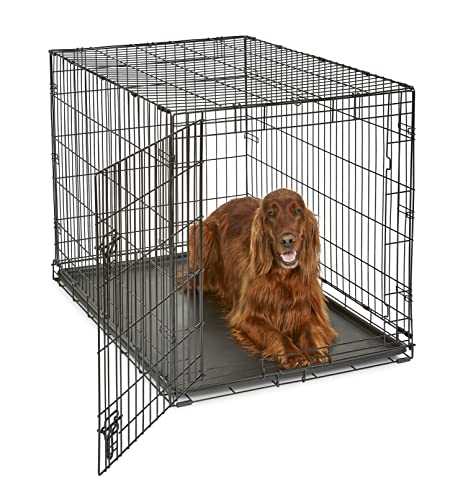
Best for Large breeds 71 to 90 lb that need a roomy single-door crate
- 42-inch single-door layout sized for large breeds
- Leak-proof removable pan for easy cleanup
- Secure slide-latch door with rounded safety corners
- Folds flat for storage and travel
- Generous interior gives a large dog room to stand and turn comfortably
- Simple single-door design is easy to place and quick to fold
- MidWest build quality with a strong owner reputation
- Single door limits placement flexibility versus a double-door model
- No divider included, so it is oversized for a puppy on day one
Verdict: Based on aggregated verified owner reviews and manufacturer specs, this is the straightforward choice for an owner who already has a large adult dog and wants proper room without paying for features they will not use. It is roomy, well built and easy to live with. If you are buying for a large-breed puppy, favour a divider-equipped crate instead so you can size it down while house-training.

Best for Car trips, vet visits and airline travel that a wire crate cannot handle
- Hard plastic shell with a wire-grille door for a more den-like enclosed feel
- Meets many airline cargo requirements (always confirm with your carrier)
- Ventilation slots on all sides and a tie-down capability
- Two-piece shell with metal-and-plastic fasteners
- Enclosed plastic sides suit dogs that settle better when den-covered
- Far more travel-ready than a folding wire crate
- Durable shell wipes clean and shrugs off knocks in a car boot
- Does not fold flat, so it takes up fixed space at home
- Less airflow and visibility than wire, which some dogs dislike
Verdict: Based on aggregated verified owner reviews and manufacturer specs, this is a travel and transport crate first, not an everyday house crate. The rigid shell protects the dog in a car and satisfies many flight rules, and the enclosed sides calm dogs that find wire crates too exposed. For daily indoor training a folding wire crate is more practical, but for anyone who actually travels with their dog this earns its place.
Best for Puppies you are house-training who will grow into a medium-large adult
- Included divider panel to size the crate down and expand it as the puppy grows
- Single-door 36-inch crate suited to 41 to 70 lb adult size
- Leak-proof removable pan that survives house-training accidents
- Folds flat with rounded corners and a secure slide latch
- Divider is the single most useful feature for house-training a puppy
- One purchase covers puppy through adult, avoiding a second crate
- Trusted MidWest build with a strong long-term owner rating
- Single door is less flexible to position than a double-door model
- 36-inch ceiling suits medium-large adults, not giant breeds
Verdict: Based on aggregated verified owner reviews and manufacturer specs, this is the crate to buy alongside a new puppy. The divider lets you keep the space just big enough to stand and turn, which is what makes crate house-training work, then opens up as the pup fills out. If your dog is already fully grown, a plain single-door crate is cheaper, but for a growing puppy the divider justifies this pick.


Frequently Asked Questions
What size crate does my dog need?
Measure your dog's length from nose to the base of the tail and its height from the floor to the top of the head when sitting, then add 2 to 4 inches to each. The dog should be able to stand fully, turn around and lie down stretched out. Avoid buying a crate that is too large, because extra space actually makes house-training harder. For a puppy, buy the adult size but choose a crate with a divider so you can shrink the space now and expand it as the puppy grows.
Wire, plastic or heavy-duty: which crate type is best?
Wire folding crates are the best all-round choice for indoor use: airy, easy to clean, and they fold flat. Plastic airline-style kennels are best for car and air travel and for dogs that prefer an enclosed, den-like feel. Heavy-duty crates are only necessary for powerful chewers or dogs that escape lighter crates, and they cost and weigh considerably more. Most owners are well served by a wire crate; only step up to heavy-duty if a standard crate genuinely cannot hold your dog.
How do I stop my dog escaping the crate?
First, rule out size and anxiety, because most escaping is really distress, not a puzzle to be solved with a bigger lock. For dogs that simply paw or nudge the door, choose a crate with secure slide-bolt latches rather than single spring clips. For a large or strong dog, a heavier-gauge crate holds up better. But if your dog is genuinely panicking and risks injuring itself, no crate alone is the answer: work with a trainer or vet on the underlying separation anxiety at the same time as using a sturdier crate.
Is it cruel to crate a dog?
Not when it is done properly. Dogs naturally seek out small, den-like spaces, and a crate introduced slowly and positively becomes a safe retreat many dogs choose on their own. It becomes cruel only when it is misused: as punishment, or for all-day confinement. Never use the crate to punish, always make it comfortable with a pad, and never leave a dog crated for long stretches every day. As a rough guide a puppy should not be crated many more hours than its age in months. Used as a den and a short-term training aid, a crate is a genuine welfare positive.