



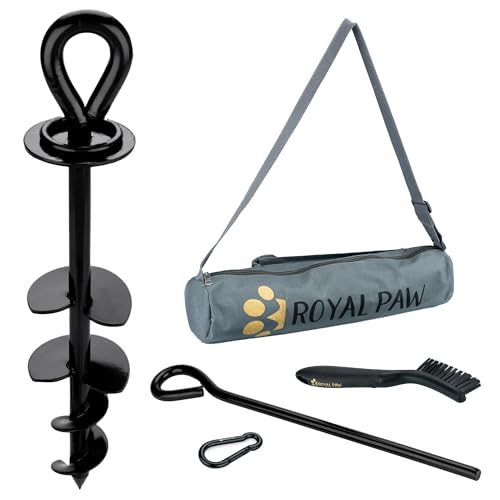
Why "Best Stake" Depends on Your Dog and Your Dirt
A tie-out stake that holds a 15-pound terrier in soft garden loam can pop straight out of the ground under a 70-pound Labrador leaning into a squirrel sighting. The stake itself isn't "good" or "bad" in the abstract, its holding power is a function of thread design, depth, and how well it grips the specific soil it's driven into. Picking the right one means matching three things: your dog's size and pull strength, your ground conditions, and the tie-out line that connects them.
Corkscrew and Auger Stakes
The most common tie-out stake is a corkscrew (auger) design: a metal shaft with a wide helical thread that you twist into the ground like a giant screw. The thread bites into surrounding soil along its whole length, which spreads holding force over a larger area than a straight spike ever could. Wider, deeper threads generally hold better than narrow, shallow ones, a stake built for a 25-pound dog and one built for an 80-pound dog often look similar but have meaningfully different thread geometry underneath.
Corkscrew stakes work best in soil that has some give: lawn, garden beds, loam, and packed dirt that isn't bone dry. They struggle in two opposite conditions, loose sand, where the thread has nothing firm to grip and can work itself loose as the dog pulls, and hard clay, shale, or rocky ground, where you physically can't twist the thread in past the first few inches. In both cases, the stake ends up shallow, and a shallow stake is a stake that pulls out.
Weighted and Plate Anchors
For ground where a corkscrew won't seat properly, patios, gravel, hardpan, RV pads, or frozen winter soil, a weighted or flat-plate anchor is the better category. These rely on mass and surface friction rather than depth: a heavy base plate, sometimes filled with sand or water, or a weighted disc that sits on top of concrete or decking. They trade portability for reliability in terrain a screw-in stake can't handle, and they're the more sensible choice anywhere digging a stake in isn't realistic or permitted, like a rented deck or a campsite with a gravel pad.
Holding Force vs. Actual Pull
Manufacturers often list a maximum holding-force rating, but that number describes steady tension, not the sudden jerk of a dog lunging at full speed to the end of the line. A hard lunge can generate several times a dog's body weight in peak force for a fraction of a second, which is why a stake rated for a dog's static weight can still fail on the first excited sprint. As a rough safety margin, size the stake and anchor system for meaningfully more than your dog's actual body weight, and size up further for a dog that's a known puller, a young dog with unpredictable impulse control, or a breed prone to explosive lunging at wildlife or passersby.
Reading Your Soil
Before buying, it's worth actually looking at the ground the stake will live in. Push a garden trowel or screwdriver into the spot at the depth the stake would reach, if it goes in with light pressure, a standard corkscrew auger should seat fine. If it stops hard within a couple of inches, you're dealing with clay, rock, or compacted fill, and a corkscrew stake will likely underperform regardless of its rated size. Sandy or very loose soil needs either a longer, wider-thread stake driven deeper than the package suggests, or a weighted anchor instead, since sand loses grip strength as it dries out over the course of a day.
Ground conditions also change with weather. Soil that holds a stake firmly when moist can loosen significantly after heavy rain saturates it, or after a hard freeze-thaw cycle heaves the ground. A stake that was solid last month is worth rechecking after any major weather shift, not assumed to still be secure.
Cable vs. Chain Tie-Out Lines
The stake is only half the system, the line running from stake to dog matters just as much.
Cable lines are lightweight, coil compactly, and resist chewing far better than rope, which makes them a common default for dogs that aren't hard chewers. Their downside is that a cable's wire strands can fatigue and fray with repeated flexing at the crimped end loops, and a large, determined dog can eventually work a lighter-gauge cable to failure, so cable gauge needs to match dog size, not just be "a cable."
Chain tie-outs are heavier and more chew-resistant than either cable or rope, making them the more durable option for a strong chewer or a dog that has destroyed cable lines before. The trade-off is weight and stiffness: a heavy chain is more likely to tangle awkwardly, drags on the dog's harness during play, and can cause a sharper, more jarring stop at the end of a lunge than a cable's slight give, one more reason a harness, not a collar, should be the attachment point (more on that in the companion safety guide).
Matching Stake to Dog, A Rough Guide
- Small dogs (under 20 lb), soft ground: a standard corkscrew stake with a lighter cable is usually sufficient.
- Medium dogs (20-50 lb): a wider-thread corkscrew driven to full depth, paired with a mid-gauge cable or light chain.
- Large or strong-pulling dogs (50 lb+): a heavy-duty, deep-thread corkscrew in good soil, or a weighted anchor in poor soil, with a chain or heavy-gauge cable rated well above the dog's body weight.
- Any dog on rocky, sandy, frozen, or paved ground: skip the corkscrew and use a weighted or plate anchor regardless of dog size.