

A Tie-Out Is a Tool, Not a Babysitter
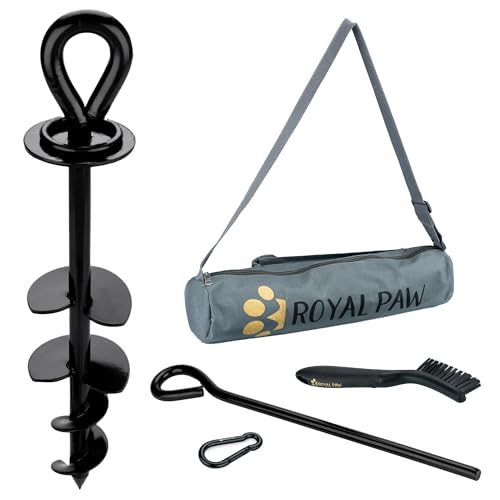
A ground stake and line can be a reasonable way to give a dog supervised outdoor time, a bathroom break, some sun, a chance to sniff around while you're gardening nearby. What it can't do is replace a fence or replace you. Every tie-out setup, no matter how well-built, carries risks that only exist because a dog is tethered and moving in circles around a fixed point, and managing those risks is what separates safe use from a genuinely dangerous one.
Never Leave a Tethered Dog Unattended
This is the single rule that matters most. An unattended tethered dog can't get away from a threat, another animal, an aggressive stray, a person who wanders too close, even severe weather rolling in, and can't be freed quickly if the line tangles, if the stake pulls loose and the dog bolts still dragging it, or if the dog collapses from heat. Tie-outs have been linked to serious injury and death in exactly these unsupervised scenarios: strangulation from a wrapped line, heatstroke with no way to reach shade or water, and attacks the dog had no ability to escape. If you can't be outside watching, the dog shouldn't be on a tie-out, full stop. A tie-out is for the time you're actually present, not a way to leave a dog "safely" outside while you're indoors or away.
Entanglement and Strangulation
A dog on a tie-out circles the stake as it moves, and every circle winds the line a little shorter unless something interrupts that, which is exactly what happens when the line catches on a step, a chair leg, a shrub, or its own back legs. As the wound-up line shortens, the dog gets pulled up short with less and less slack, and if the line is attached to a collar rather than a harness, that shortening tension lands directly on the neck. A panicking dog pulling against a tightening collar is a strangulation risk, not just an inconvenience, dogs have died this way. Even without full entanglement, a sudden hard stop at the end of a taut line transmits real force through whatever it's attached to.
Harness, Not Collar
This is the fix for most of the above: attach the tie-out line to a well-fitted body harness, never a flat or slip collar. A harness spreads sudden stopping force across the chest and shoulders instead of concentrating it on the throat and cervical spine, so a hard lunge or an entanglement-driven pull doesn't risk airway injury or neck trauma the way a collar-based stop does. Keep a separate ID collar on for identification, but make the harness the actual attachment point for anything involving a tie-out.
Swivel Hardware
Use a line with a rated swivel clip at both ends, where it attaches to the stake and where it attaches to the harness. A swivel lets the line rotate freely as the dog moves in circles instead of the cable or chain itself twisting up on itself, which is what causes a line to shorten unpredictably and cinch a dog in close to the stake. Check swivel points periodically for rust, stiffness, or a clip that no longer spins freely, a seized swivel defeats the purpose and behaves like a fixed line.
Clear the Circle Before You Clip On
Before tethering a dog, walk the full radius the line will cover and physically remove or account for anything it could wrap around: outdoor furniture, garden stakes, fencing, trees, hoses, other tie-out lines if more than one dog is out, and anything a passing person or animal could get tangled in from the other direction. Make sure the radius doesn't reach a property line, a street, or a neighboring yard where the dog could contact another animal or a stranger while still tethered and unable to retreat.
Water, Shade, and Weather
Any time a dog is tied out, water and shade need to be within reach for the entire time, not placed once at the start and then out of reach after the dog has circled the stake a few times. Shade in particular moves with the sun, so a spot that was shaded at 10am can be full sun an hour later; check on the dog often enough to notice that shift. On hot days, also check pavement or decking surface temperature, if it's too hot for your bare palm for five seconds, it's too hot for paw pads. In cold, wet, or stormy weather, a tie-out session should be short and supervised, with the dog brought inside well before conditions turn genuinely uncomfortable or dangerous.
Keep Sessions Short and Supervised
Treat a tie-out as a short, watched activity, a bathroom break or an hour of supervised yard time, rather than a general containment method. The longer a dog is tethered, the more the risks above compound: more time for weather to shift, more opportunities to wind the line short, more chances for something or someone to wander into range. For anything beyond brief supervised periods, a securely fenced area or an attended outing is the safer choice, with the tie-out reserved for the moments a fence genuinely isn't available.